Sheep have been one of the constants of this long walk. I have no clue how many I’ve seen, but it must be thousands or even tens of thousands by this point.
Which, of course, has me thinking about the Good Shepherd and the sheep of his flock.
Far from my friends and acquaintances, I find myself in a strange land where as yet I know but very few people. But I know Thee, O Jesus, Thou Son of the Highest, as my Immanuel, my Brother, and my best Friend. Therefore I now turn to Thee, and humbly beseech Thee to have mercy upon me and not forsake me till I return to my home, yea, till I come to Thee in Thy heavenly kingdom. Thou hast given to Thine own the comforting assurance: ‘Lo, I am with you alway, even unto the end of the world.’ Fulfil this promise in me, and let me always and everywhere feel Thy gracious presence. Amen.
Starck, Johann Friedrich. John Frederick Starck’s Daily Hand-book in Good and Evil Days; Containing All the Meditations and Prayers of the Complete German Original Edition, Together with an Appropriate Selection of Standard English Hymns for General Use, for the Afflicted, the Sick, and the Dying. Translated by Joseph Stump. Third edition. (Burlington, Iowa: German Literary Board, 1904), pages 599-600.
———-
I will probably be using more from Starck’s book (with abbreviated citation!). It was extremely popular among Germans and German-Americans from the time it was 1st published in the 1700s. The first edition of this translation was in the late 1800s. It shows its age, but Starck’s faith shines through.
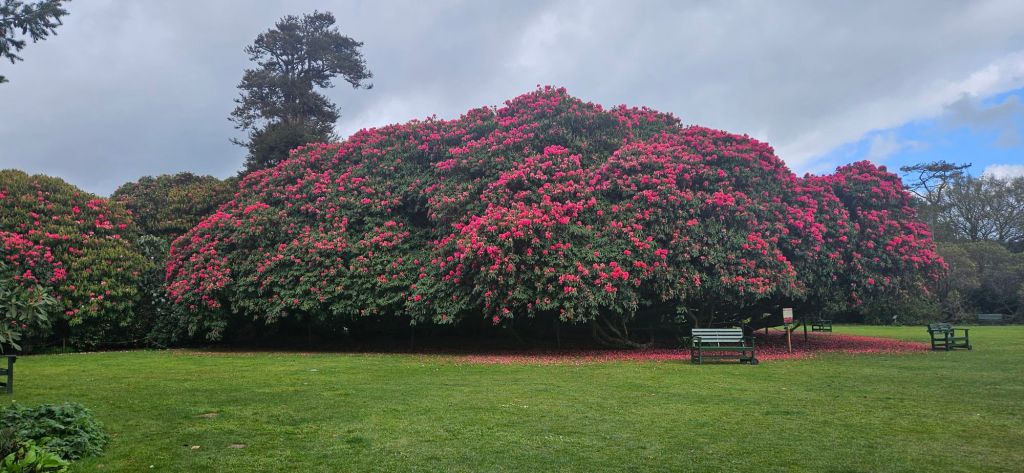
A rhododendron planted in the 1860s at the Lost Garden of Heligan, Cornwall, UK
“Social and public prayers hold groups and religions together, but they do not necessarily transform people at any deep level. In fact, group certitude and solidarity often becomes a substitute for any real journey of our own. Hear this clearly. I am not saying there is no place for public prayer, but we do need to heed Jesus’ very clear warnings about it.”
Rohr, Richard. The Naked Now: Learning to See as the Mystics See. New York: Crossroad Publishing, 2009, pp. 72-3
“If all things are his, you ought to keep your peace and let God administer all as he wishes. If he takes that which belongs to him, he is not dealing unjustly with you.”
Luther, Martin. “An Exposition of the Lord’s Prayer for Simple Laymen” (1519) Luther’s Works Vol. 42. Philadelphia: Fortress Press, 1969, page 32
Comment: Sometimes our prayers are complaints to God about what we don’t have and what we have lost for one reason or another. Luther tells us to instead let God be God in these matters. God, as creator and ruler of everything there is, has the right to shuffle around resources, taking from one and giving to another. He’s in charge, we aren’t.
“It is an old and a good practice that the pastor has set apart especially the first hour of the day for uninterrupted communion with God. The mind is then clearer and better fitted to true devotion. There is less danger of being interrupted.”
Gerberding, G. H. (George Henry), The Lutheran Pastor. 7th edition. Minneapolis : Augsburg, 1915, p. 197
“At the Hermitage we use an axiom that remains true: if you really want to do ministry well, then be content with stillness. It is only in the power of finding the Spirit in stillness that our ministry can really have the power of the Spirit in it at all. Plus, we recognize that behind every successful active ministry, there is usually a group of contemplative people praying in stillness for its success.”
Talbot, John Michael. The Universal Monk: The Way of the New Monastics. Collegeville, MN: Liturgical Press, 2011, pp. 67-68.
“Why should I pray? Basically it is for the sake of praying. There is much else we might claim about prayer–it is for the sake of the world, it is for those in need, for the Church, for individual souls–all of which is true. But unless it is rooted in the boundless freedom of love and confidence in God, it is void and crippled. It has some effect perhaps, but lacks the current of grace and graciousness that flows from God.”
Quenon, Paul. In Praise of the Useless Life: a Monk’s Memoir. Notre Dame, IN: Ave Maria Press, 2018, p. 5.
“The duration of prayer influences its quality, because a longer period of time helps the body assume a deeper prayer stance. In addition to this irreplaceable prolonged prayer, it is important during the day to consecrate the present moment by reciting a few invocations. One of them, the Angelus, has a long tradition in the Church. … Moreover, even in very different places, knowing that at that precise moment all are praying with the same formula strengthens our awareness of being interdependent in Christ.”
Okumura, Augustine Ichiro. Awakening to Prayer. Translated by Theresa Kazue Hiraki and Albert Masaru Yamato. Washington, DC: ICS Publications, Institute of Carmelite Studies, 1994, p. 64.
“Although God lives in the souls of men who are unconscious of Him, how can I say that I have found Him and found myself in Him if I never know Him or think of Him, never take and interest in Him or seek Him or desire His presence in my soul? What good does it do to say a few formal prayers to him and then turn away and give all my mind and all my will to created things, desiring only ends that fall far short of Him?”
“Most spiritual practices will eventually lose their freshness and become a source of boredom and tedium. But it is precisely there that our faith and determination are tried, and it is only through grace-filled faith and perseverance that we are able to reach the hidden treasures of these practices. It takes time–day after day and year after year–before these treasures come to light. We must stick to it.”
Talbot, John Michael. The World is My Cloister: Living From the Hermit Within. Maryknoll, NY: Orbis Books, 2010, page 121.
 Pathology: the Study of a Path