Almost a week in…

And it’s clear I’m not a professional blogger. I get to the end of my walking day and writing/editing a lot isn’t the first thing on my mind.

Since I am trying mostly to “wild camp” – that we call “stealth camping” in the US – what is on my mind is to find a place to camp, to set up my tent so it’s quite inconspicuous, get something to eat, and go to bed. And sometimes that means waiting until it is closer to sunset.

Wild camping is technically illegal, I have read, but I’ve also read that campers are only very rarely told to move on. It would be a civil offense not criminal, but if one refused to move after the landowner told you to, it could escalate to criminal. Scotland is different.

But it’s hard, as far as I can tell, to figure out who the landowner is so you can ask permission.

During the day when I’m out walking, I stick to the lanes and roads. No problems there, except that so many of the ones that my route uses are maybe a lane and a half wide. And since the Cornish farmers enjoyed building their hedges (now protected historic treasures) the sides of the roads are 6 to 10 foot high rugged plant matter usually with a core stone wall. (There’s some sort of sermon illustration in there.)
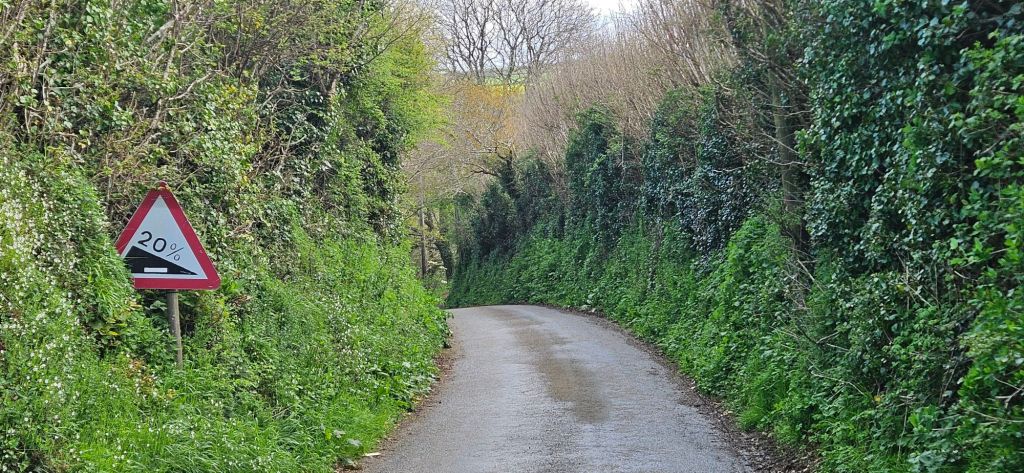
Narrow lane and hedges in Cornwall

Generally the hedges block the sun and wind. They also sometimes block a long ahead view of oncoming traffic. But since they also contain the sound, I hear the vehicles before we see each other. I’m wearing an orange safety vest on my left shoulder as a flag, too. I turn to the hedge and get as far to the side as I can. The drivers seem used to this.

Anyway, I have been to several churches and want to share the prize so far: the Quaker Meetinghouse in Come for Good, built in 1707. Amazing thatched roof and, of course, simple interior.
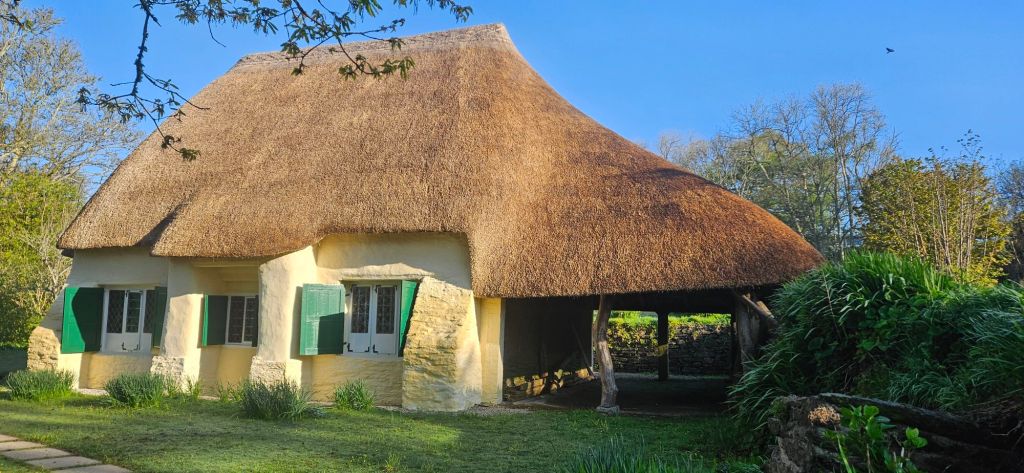
Friends Meetinghouse,  Come for Good, UK

I’ve passed several “disused” church buildings, too. That is, no longer used by the Church as a place of worship. One is now a preschool. Another is a private home. And so on. Some are “listed” as historically significant.

I’ve also discovered that among the Anglicans (maybe others, too) there’s a movement or program to have “open churches” unlocked and available through the day to anyone who wants to come in for quiet and prayer. Or just to look at the stained glass. Ann suggested that a pilgrim might also ask whether he could spend the night as a place if sanctuary. If the opportunity arises, I’m intending to ask.
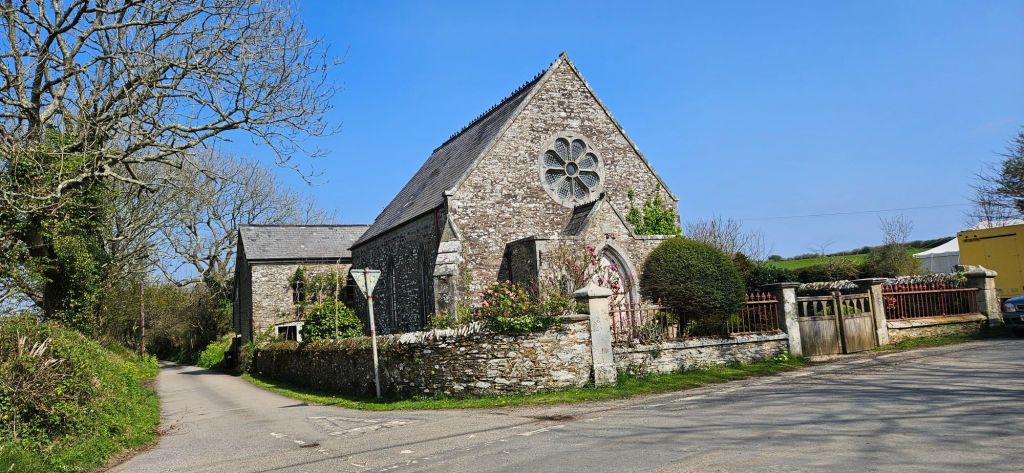
Disused church building now a private home in Cornwall, UK

OK, another issue with blogging from the pilgrim path is having a good enough connection. I am tenting tonight in a commercial campground for the first time. It’s next to the Lost Garden of Heligan, and was at the right place for me today when I needed to stop. But I’m not getting a strong enough signal to upload photos. Some other nights I have put up in a valley, so poor signal. Or out too far. Cornwall is pretty rural, though, so as I go north that may change (at least until the wilds of Scotland).

Which reminds me, my main map is from the Ordnance Survey (they’re like – and maybe better than – the USGS topographic maps in the US). They show all the wooded patches. And it only becomes clear on the ground that some of those patches are too steep to till so that’s why they were left in trees; or that they’re marshy; or that the scrub between the trees is imoenatrable; or that a particular wood is fenced off with a 6 foot tall fence topped with 2 strands of barbed wire. (Such a fence surprised me last night, so I had to pitch up in sight of a house.) I’m learning to be flexible.

Those are the kinds of things that God is working on with me do far. That, and not being able to walk as far in a day as I had hoped.

Be well.

when God thwarts our will

“God’s only purpose in thwarting our good will is to make of it a better will. And this is done when it subordinates itself to and conforms to the divine will (by which it is hindered), until the point is reached when man is entirely unfettered by his own will, delivered from his own will, and knows nothing except that he waits upon the will of God.”

Luther, Martin. “An Exposition of the Lord’s Prayer for Simple Laymen” (1519) Luther’s Works Vol. 42. Philadelphia: Fortress Press, 1969, page 47.

seeing God

“By his own powers man cannot see God, yet God will be seen by men because He wills it. He will be seen by those He chooses, at the time He chooses, and in the way He chooses, for God can do all things. He was seen of old through the Spirit in prophecy; He is seen through the Son by our adoption as his children, and He will be seen in the kingdom of heaven in His own being as the Father. The Spirit prepares man to receive the Son of God, the Son leads him to the Father, and the Father, freeing him from change and decay, bestows the eternal life that comes to everyone from seeing God.

“As those who see light are in the light sharing its brilliance, so those who see God are in God sharing His glory, and that glory gives them life. To see God is to share in life.”

Saint Irenaeus. Adversus Haereses or Against Heresies. Quoted in Office of Readings for Wednesday of the Third Week in Advent, (vol. 1, p. 288) and cited there as: Lib 4, 20, 4-5: SC 100, 634-640.

Note: Seeing God isn’t usually physical seeing, just as knowing God isn’t intellectual knowing. But understand that God was seen, is seen, and will be seen.

Saint Irenaeus also makes an interesting flip by saying that the former was through the Spirit, the middle in the Son, and the latter in the Father. (I think we usually say of old through the creating Father, then in the incarnate Jesus, and ultimately in the Holy Spirit’s leading the Church. So I suppose we’re the ones making the flip.)

what God wants of us

Note:
A perennial question among (some) Christians is about what is God’s will for our lives, what God wants us to do. In real practical terms. Things like: Should I go to this school or that? Major in this or that? Take this job or not? Marry which person? Buy this car or house, or that one?

Werner Elert explains that — based on what Jesus said in the Gospels (which should carry great authority for His followers) — maybe it just doesn’t matter so much to God. Those kinds of specific answers, those tasks, all that is small potatoes in the Christian life. What matters to the Father, what Jesus tells us, what the Spirit whispers in our ears is that we need to love God and love our neighbor. The specifics we aren’t going to get. We don’t need them. And we absolutely don’t need to stress over them.

Quote:
“If we expect the Lord and Master to assign a definite list of tasks to us, we shall be disappointed. Obedience is usually felt as compulsion. Many experience it as a welcome compulsion which gives them the feeling that they are secured in a stronger will and relieves them of the odious necessity of making their own decisions. However, the quest for particular assignments in specific situations is futile under the authority of Christ. In economic distress or national emergencies we often receive puzzling replies to our questions — How many calories? What shall we eat? What shall we wear? Christ answers: ‘Look at the birds of the air.’ That is unfortunately not the kind of exact answer we want. When I ask where to find shelter, his answer is, ‘The Son of man has not where to lay his head.’ Guidance in legal difficulties? ‘Man, who has made me a judge or divider over you?’ Advice in tax matters? ‘Render to Caesar the things that are Caesar’s.’ ‘Entirely unnecessary,’ says Jesus, whether I should attend a funeral, even though not attending would be socially impossible. It even appears that Jesus mocks the weather forecasters. [Matt. 16:2] If an individual with strong needs of dependency chooses ‘obedience toward Christ’ as a means of receiving specific directions which will relieve him of personal decisions and planning, he will be sadly disappointed.” (p. 251)

Source: Elert, Werner. The Christian Ethos. Philadelphia: Muhlenberg Press, 1957.