Almost a week in…

And it’s clear I’m not a professional blogger. I get to the end of my walking day and writing/editing a lot isn’t the first thing on my mind.

Since I am trying mostly to “wild camp” – that we call “stealth camping” in the US – what is on my mind is to find a place to camp, to set up my tent so it’s quite inconspicuous, get something to eat, and go to bed. And sometimes that means waiting until it is closer to sunset.

Wild camping is technically illegal, I have read, but I’ve also read that campers are only very rarely told to move on. It would be a civil offense not criminal, but if one refused to move after the landowner told you to, it could escalate to criminal. Scotland is different.

But it’s hard, as far as I can tell, to figure out who the landowner is so you can ask permission.

During the day when I’m out walking, I stick to the lanes and roads. No problems there, except that so many of the ones that my route uses are maybe a lane and a half wide. And since the Cornish farmers enjoyed building their hedges (now protected historic treasures) the sides of the roads are 6 to 10 foot high rugged plant matter usually with a core stone wall. (There’s some sort of sermon illustration in there.)
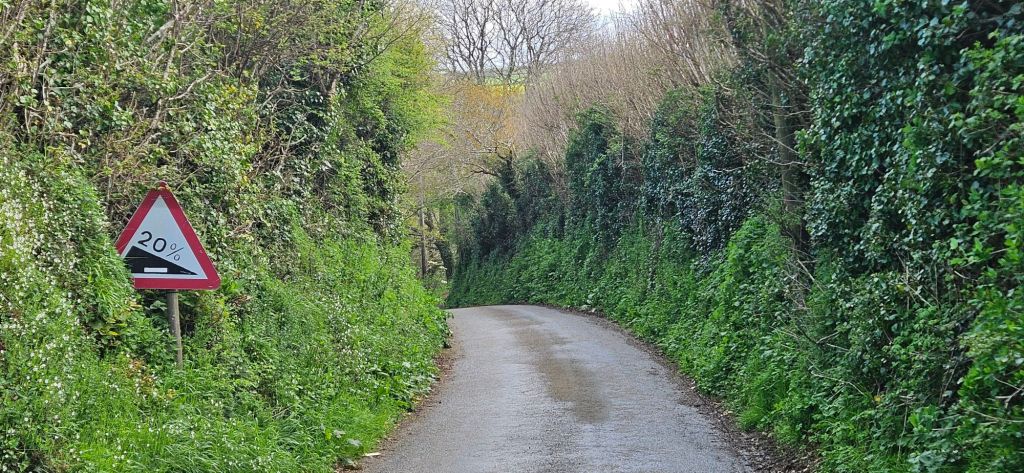
Narrow lane and hedges in Cornwall

Generally the hedges block the sun and wind. They also sometimes block a long ahead view of oncoming traffic. But since they also contain the sound, I hear the vehicles before we see each other. I’m wearing an orange safety vest on my left shoulder as a flag, too. I turn to the hedge and get as far to the side as I can. The drivers seem used to this.

Anyway, I have been to several churches and want to share the prize so far: the Quaker Meetinghouse in Come for Good, built in 1707. Amazing thatched roof and, of course, simple interior.
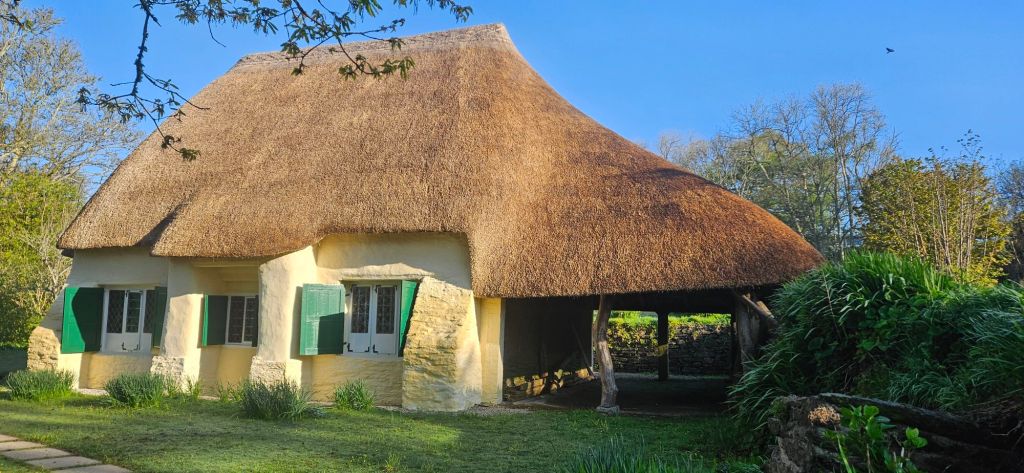
Friends Meetinghouse,  Come for Good, UK

I’ve passed several “disused” church buildings, too. That is, no longer used by the Church as a place of worship. One is now a preschool. Another is a private home. And so on. Some are “listed” as historically significant.

I’ve also discovered that among the Anglicans (maybe others, too) there’s a movement or program to have “open churches” unlocked and available through the day to anyone who wants to come in for quiet and prayer. Or just to look at the stained glass. Ann suggested that a pilgrim might also ask whether he could spend the night as a place if sanctuary. If the opportunity arises, I’m intending to ask.
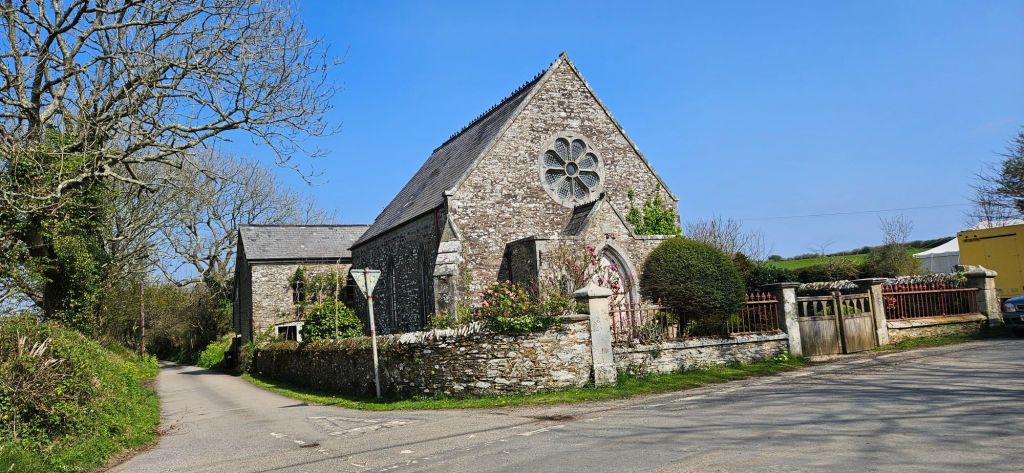
Disused church building now a private home in Cornwall, UK

OK, another issue with blogging from the pilgrim path is having a good enough connection. I am tenting tonight in a commercial campground for the first time. It’s next to the Lost Garden of Heligan, and was at the right place for me today when I needed to stop. But I’m not getting a strong enough signal to upload photos. Some other nights I have put up in a valley, so poor signal. Or out too far. Cornwall is pretty rural, though, so as I go north that may change (at least until the wilds of Scotland).

Which reminds me, my main map is from the Ordnance Survey (they’re like – and maybe better than – the USGS topographic maps in the US). They show all the wooded patches. And it only becomes clear on the ground that some of those patches are too steep to till so that’s why they were left in trees; or that they’re marshy; or that the scrub between the trees is imoenatrable; or that a particular wood is fenced off with a 6 foot tall fence topped with 2 strands of barbed wire. (Such a fence surprised me last night, so I had to pitch up in sight of a house.) I’m learning to be flexible.

Those are the kinds of things that God is working on with me do far. That, and not being able to walk as far in a day as I had hoped.

Be well.

one Catholic view of Martin Luther

“We must see the decisive point here: more than anyone before him in the fifteen hundred years of church history, Luther had found a direct existential access to the apostle Paul’s doctrine of justification of the sinner by faith alone, and not through works. This had been completely distorted by the promotion of indulgences in the Catholic Church, which claimed that the sinner could be saved by performing set penances and even making payment of money. This rediscovery of Paul’s message of justification – among the shifts, obscurities, cover-ups, and overpaintings – is an epoch-making and astounding theological achievement, which the Reformer himself always recognized as the special grace of God. Simply in the light of this central point, a formal rehabilitation of Luther and the repeal of his excommunication by Rome is overdue. It is one of those acts of reparation which should follow the pope’s confession of guilt today.”

Küng, Hans. The Catholic Church: a Short History. New York: The Modern Library, 2003, p. 126

a source for the apophatic

“As an approach in spirituality, the apophatic tradition can be traced to yet another source in the fourth century. The monastic experience of early desert dwellers like Evagrius of Pontus gave rise to the discipline of prayer which paralleled the negative way. Living at Nitria in the wilderness west of the Nile, desert silence and simplicity taught him the relinquishment of self that accompanies the renunciation of language.”

Lane, Belden C. The Solace of Fierce Landscapes: Exploring Desert and Mountain Spirituality. New York: Oxford University Press, 1998, p. 64.

Mary and Martha

"The mystics in history have also offered different ways of understanding Mary and Martha. The fourteenth-century manual of contemplation The Cloud of Unknowing suggests that Mary represents the contemplative life while Martha symbolizes the active life. In other words, Mary stands for those who live in cloistered communities of monks or nuns, devoting their lives to prayer and meditation, while Martha represents those who live ‘in the world,’ with families and households and the ordinary responsibilities of secular life.

“… On the other hand, Teresa of Avila in her mystical masterpiece The Interior Castle refuses to see one sister as somehow more exalted than the other.”

McColman, Carl. The New Big Book of Christian Mysticism: an Essential Guide to Contemplative Spirituality. Minneapolis: Broadleaf Books, 2023, p. 95.

secrets revealed

“While it is unclear just how the Greek concept of mystery influenced early Christianity, the concept of mystery as ‘hiddenness’ appears in the writings of the apostle Paul and other early Christian mystics–even as it has an entirely different flavor from the pagan contexts out of which the language of mystery emerged. The earliest Christian mystics don’t talk about ritual secrets that only initiates can access; rather they talk about secrets that are revealed–through Christ, through the Bible, through the Christian sacraments, and eventually, through personal experiences of the presence of God.”

McColman, Carl. The New Big Book of Christian Mysticism: an Essential Guide to Contemplative Spirituality. Minneapolis: Broadleaf Books, 2023, p. 59.

one Catholic theologian’s view

“Under the direction of Pius IX, an emotionally unstable man untroubled by intellectual doubt who evinced the symptoms of a psychopath, the medieval Counter-Reformation Catholic fortress was now built up against modernity with all available powers. The chill of religious indifference, hostility to the church, and a lack of faith might prevail outside in the modern world. But within, papalism and Marianism disseminated the warmth of home: emotional security through popular piety of every kind, from pilgrimages through devotions for the masses to the May prayers to Mary.”

Küng, Hans. The Catholic Church: a Short History. New York: The Modern Library, 2003, page 161.

image and likeness

“In Christian scripture, following the Septuagint tradition, tselem was normally translated by the Greek term eikon (see Col. 1:15, etc.). ‘Likeness’ was rendered by homoiosis or homoioma and their cognates, a linguistic fact that would bear difficult fruit in the great Christological controversies that split the early Church between Orthodoxy and Arianism. Eikon, of course, is the same as ‘icon’ in English, and still refers to the sacred image. It is worth noting that the centuries-long dispute in the Eastern Church, as well as later in Puritan England and New England regarding the propriety of sacred images, has its roots in the apophatic rejection of any representations of the unseen, invisible, incomprehensible God.”

Woods, Richard. Meister Eckhart: Master of Mystics. New York: Continuum, 2011, p. 141.

including the Church triumphant

“We are to be informed by the life, teaching, death and resurrection of Jesus; by the leading of the Spirit; by the wisdom we find in scripture; by the fact of our baptism and all that it means; by the sense of God’s presence and guidance through prayer; and by the fellowship of other Christians, both our contemporaries and those of other ages whose lives and writings are ours to use as wise guides. … Part of the art of being a Christian is learning to be sensitive to all of them, and to weigh what we think we are hearing from one quarter alongside what is being said in another.”

Wright, Tom. Simply Christian. London: SPCK, 2006, p. 191.

the Camaldolese “three-fold good”

“The classical text of the threefold good, or threefold advantage (tripla commoda), is found where Bruno gives an account of Otto III’s project of choosing some of the more fervent disciples of Romuald as missionaries to Poland. There they were to build a monasterium in Christian territory near an area where pagans dwelt, secluded and surrounded by woods: ‘This would offer a threefold advantage: the cœnobium, which is what novices want; golden solitude, for those who are mature and who thirst for the living God; and the preaching of the gospel to the pagans, for those who long to be freed from this life in order to be with Christ’.”

Wong, Joseph. “The Threefold Good: Romualdian Charism and Monastic Tradition.” in Belisle, Peter-Damian, editor. The Privilege of Love: Camaldolese Benedictine Spirituality. Collegeville, Minn.: Liturgical Press, 2002, p. 82.

Thomas Aquinas and exclusion

“Thomas already makes that fatal statement ‘that to be subject to the Roman pope is necessary for salvation.’ In one sentence he is excluding the whole of the eastern Church from salvation.”

Küng, Hans. The Catholic Church: a Short History. New York: The Modern Library, 2003, p. 103.

Comment: …and many others as well!