As of today, Monday 9th June, I am in the city of Carlisle, Cumbria, in way northwest England. About 10 miles of walking from here is where I cross the border into Scotland.
Meditation
Colossians 3:2-3: “Set your mind on things above, not on earthly things. For you died, and your life is now hidden with Christ in God.”
There are times we Christians forget this, both in our pilgrimage life and in our other life.
Read moreCoincidence?
Coincidences seem to pop up quite at random. Some, I don’t believe, are random at all.
Read moreLEJOG Pilgrimage Church Visits on Wednesday 23 April
There’s a saying, isn’t there, that timing is everything. And God’s timing is the sweetest.
Starting with the First Step
My first steps were actually leaving home with Ann on Sunday afternoon as she drove me to Dulles Airport. But today I took the first of my footsteps carrying me the length of the United Kingdom.
After eating that modified full English breakfast I walked town a bit waiting for 11:00 bus, which left station at 11:08 and drove me back past Lugger Inn. We arrived just an hour later in Land’s End. (Ten miles or so took an hour due to several stops, and to the narrow teisting roads – some are really only a lane and a half wide, have two way traffic, and random parking half on and half off the pavement. Reminded me a little of driving in New York City except that everyone here seem much more polite about waiting for the other driver and taking turns.)
I walked around Land’s End for about an hour. With the several kindred other people who were also visiting. Took some photos. Met an old friend from Peru who said we should take a photo together.
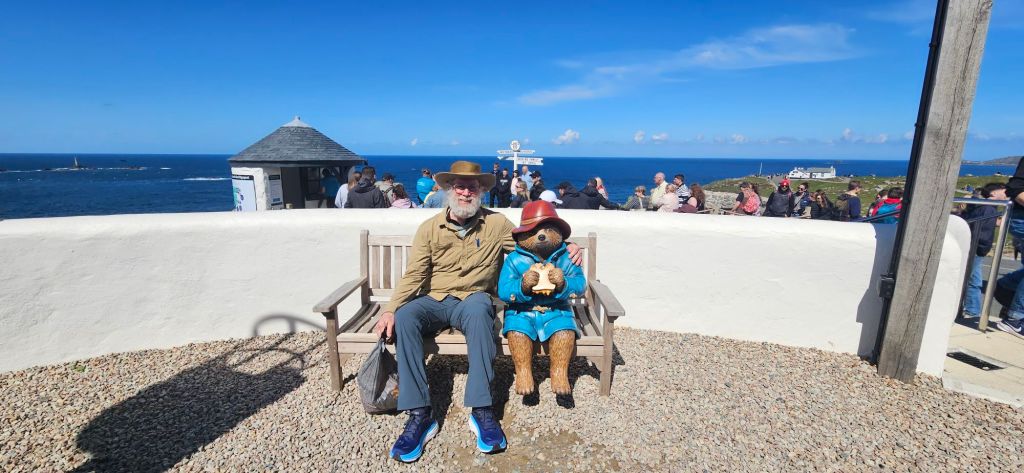
The famous signpost behind us says it’s 3,147 miles to New York. Which helps explain the polite drivers maybe.
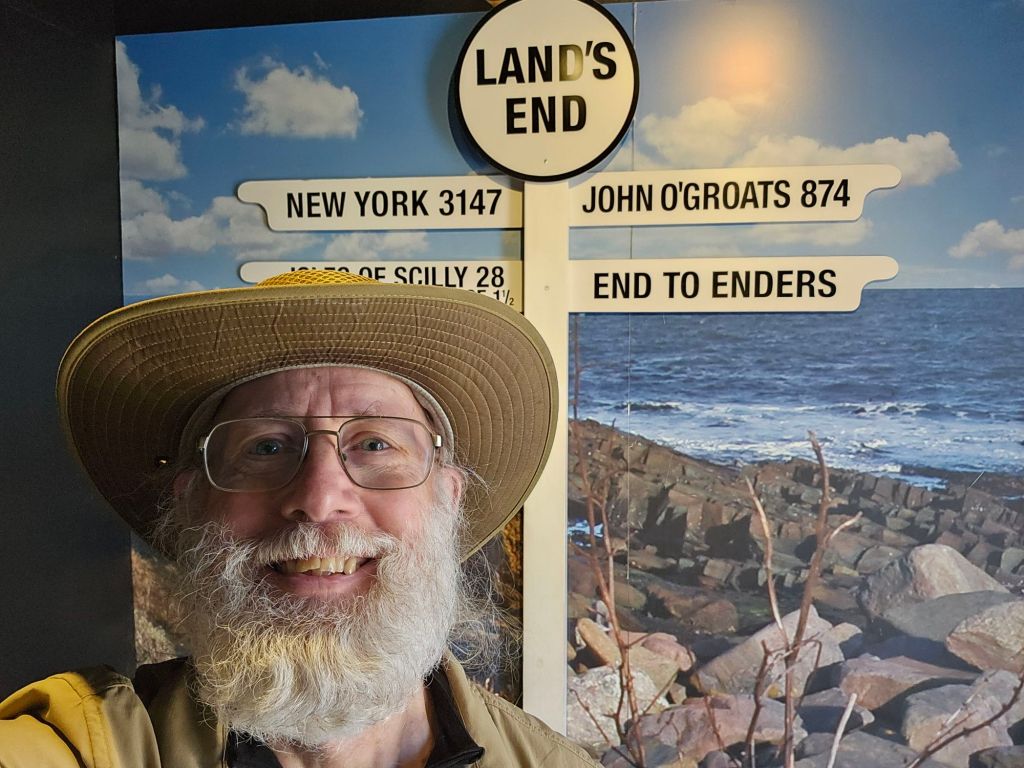
They have a nice exhibit about LEJOG end-to-enders in one of their buildings. All about the history of doing it, and the variety of ways, as well as various records set. It only attracted one tourist while I was on site.
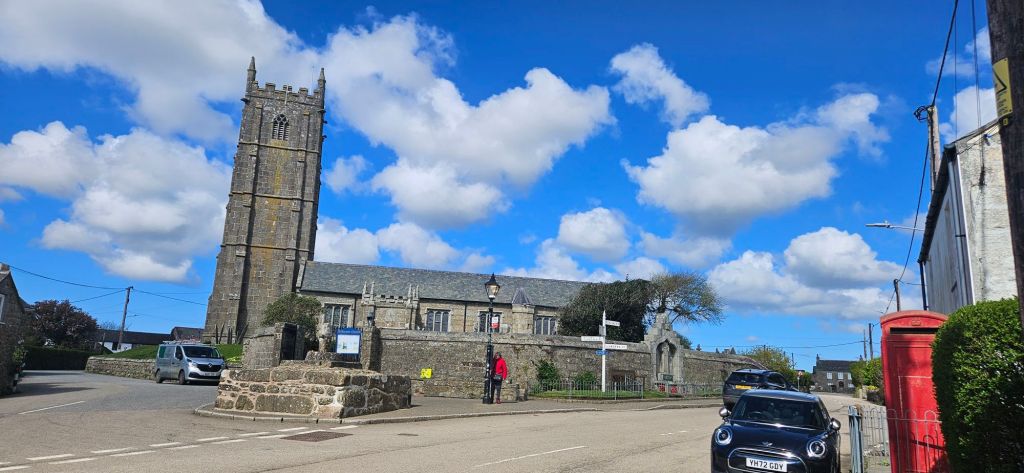
I started walking at 1:18 pm. Walked through farmland most the day. And arrived at St Buryan around 3:15. The Anglican church there is open all day to visitors, so I went in and prayed, took a few photos of the interior, walked a little of the graveyard, and then sat on a bench outside having snacks.
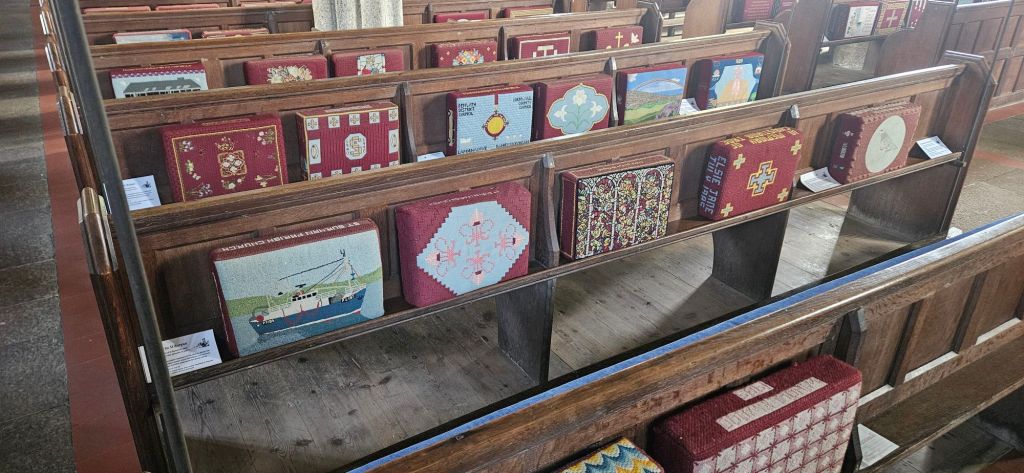
I haven’t seen a device like this in a church before:

The signpost outside said it’s 5 miles to Penzance. I set off at 3:43 for the second half of today’s walk and got back to the inn at 5:45.
After dinner at the Inn, I went to a grocery to feed myself the next few days.
And, so, goodnight.
LEJOG as pilgrimage
Okay, fine, the last posts explain what a LEJOG is, but why do it?
A goodly number of the people do this trek to raise funds for a charity. Those are the people who post and boost videos during their trip. LEJOGers who aren’t trying to reach more potential donors don’t have the same need to publicize their efforts. But there are other reasons to walk 1,000 miles.
Read morehearing God
“The silence of the Church’s life, it seems to me, is connected to the mystery and gentleness of the divine voice. In order to hear it, you have to turn your ear because the Holy Spirit does not speak loudly, nor do Jesus and his Father. When the Word became man and came to live in Nazareth, for thirty years the Nazarenes saw nothing! It takes time and silence, therefore, to discern the voices of heaven, which are discreet and infinitely respectful.”
Dom Dysmas de Lassus, the Father General of the Carthusian Order at Grande Chartreuse in: Sarah, Robert Cardinal with Nicolas Diat. The Power of Silence Against the Dictatorship of Noise. Translated by Michael J. Miller. San Francisco: Ignatius Press, 2017, pp. 221-222
saints as family and in the mirror
“This is our family in the spiritual order, the family of saints. And we also are saints. You may not think of yourself as exactly a saint, but if you are a sincere seeker after wholeness, then you belong to this community. I’m sure that not all the Romans and Corinthians Paul addressed as ‘saints’ were paragons of virtue, but it was their vocation, and is ours, to strive to fulfill Jesus’ command to love him by loving one another. We should believe in ourselves as saints. If we celebrate November 1 as All Saints’ Day, we should claim it and enjoy it as our feast day. If we recite the Apostles’ Creed, we should turn our attention seriously to believing in ‘the communion of the saints’ and asking what that means.”
Bruteau, Beatrice. Radical Optimism: Practical Spirituality in an Uncertain World. Boulder, CO: Sentient Publications, 2002, p. 104
everything is available
from the epilogue of this book: "To desire the Parousia, all we have to do is to let the very heart of the earth, as we christianize it, beat within us.
"Why then, O people of little faith, do you fear or repudiate the progress of the world? Why foolishly multiply your warnings and your prohibitions? ‘Don’t venture . . . Don’t try . . . everything is known: the earth is empty and old; there is nothing more to be discovered.’
“We must try everything for Christ! We must hope everything for Christ! ‘Nihil intentatum!’ (‘Leave nothing unattempted!’) That, on the contrary, is the true christian attitude.”
Teilhard de Chardin, Pierre. The Divine Milieu. Translated by Siôn Cowell. Portland, OR: Sussex Academic Press, 2012, p. 117
Comment: Looking at this now, quite some time after I first read it, I see again how thick Teilhard’s writing can be. Or can appear. I’ve found in the little of his work that I have read that I need to take it in small mouthfuls and sit with it quietly before moving on. Also, yes, grabbing a few sentences from the end of his book and sharing them without all the underlying and preparatory thought is not the best introduction.
small groups in congregations
“Ideally every Christian should belong to a group that is small enough for individuals to get to know one another, care for and particularly to pray in meaningful depth for one another, and also to a fellowship large enough to contain a wide variety in its membership, its styles of worship and its kingdom-activity. The smaller the local community, the more important it is to be powerfully linked to a larger unit. The larger the regular gathering (I think of those churches where several hundred, or even several thousand, meet together every week), the more important it is for each member to belong also to a smaller group. Ideally, groups of a dozen or so will meet to pray, study scripture and build one another up in the faith.”
Wright, Tom. Simply Christian. London: SPCK, 2006, p. 181
Comment: Bishop Wright makes his case for small groups in the congregation, but without invoking either psychology, or sociology, or Jesus and the Twelve. It is built on a network of supportive relationships within the group. Good for most people in most places, I guess, to belong both to a small group and to a larger fellowship.
 Pathology: the Study of a Path