Prayer of One Who is Living in a Strange Land


Far from my friends and acquaintances, I find myself in a strange land where as yet I know but very few people. But I know Thee, O Jesus, Thou Son of the Highest, as my Immanuel, my Brother, and my best Friend. Therefore I now turn to Thee, and humbly beseech Thee to have mercy upon me and not forsake me till I return to my home, yea, till I come to Thee in Thy heavenly kingdom. Thou hast given to Thine own the comforting assurance: ‘Lo, I am with you alway, even unto the end of the world.’ Fulfil this promise in me, and let me always and everywhere feel Thy gracious presence. Amen.

Starck, Johann Friedrich. John Frederick Starck’s Daily Hand-book in Good and Evil Days; Containing All the Meditations and Prayers of the Complete German Original Edition, Together with an Appropriate Selection of Standard English Hymns for General Use, for the Afflicted, the Sick, and the Dying. Translated by Joseph Stump. Third edition. (Burlington, Iowa: German Literary Board, 1904), pages 599-600.

———-

I will probably be using more from Starck’s book (with abbreviated citation!). It was extremely popular among Germans and German-Americans from the time it was 1st published in the 1700s. The first edition of this translation was in the late 1800s. It shows its age, but Starck’s faith shines through.

A rhododendron planted in the 1860s at the Lost Garden of Heligan, Cornwall, UK

Starting with the First Step

My first steps were actually leaving home with Ann on Sunday afternoon as she drove me to Dulles Airport. But today I took the first of my footsteps carrying me the length of the United Kingdom.

After eating that modified full English breakfast I walked town a bit waiting for 11:00 bus, which left station at 11:08 and drove me back past Lugger Inn. We arrived just an hour later in Land’s End. (Ten miles or so took an hour due to several stops, and to the narrow teisting roads – some are really only a lane and a half wide, have two way traffic, and random parking half on and half off the pavement. Reminded me a little of driving in New York City except that everyone here seem much more polite about waiting for the other driver and taking turns.)

I walked around Land’s End for about an hour. With the several kindred other people who were also visiting. Took some photos. Met an old friend from Peru who said we should take a photo together.

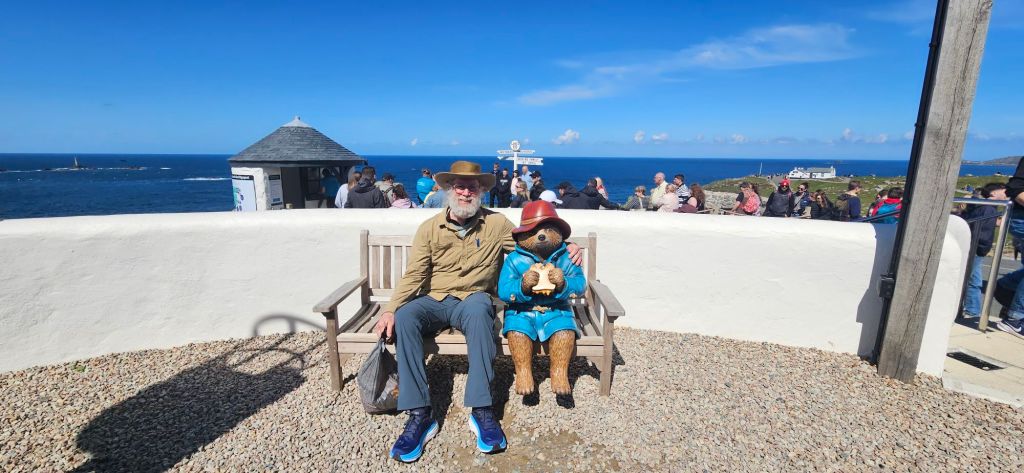
Paddington and me at Land’s End.

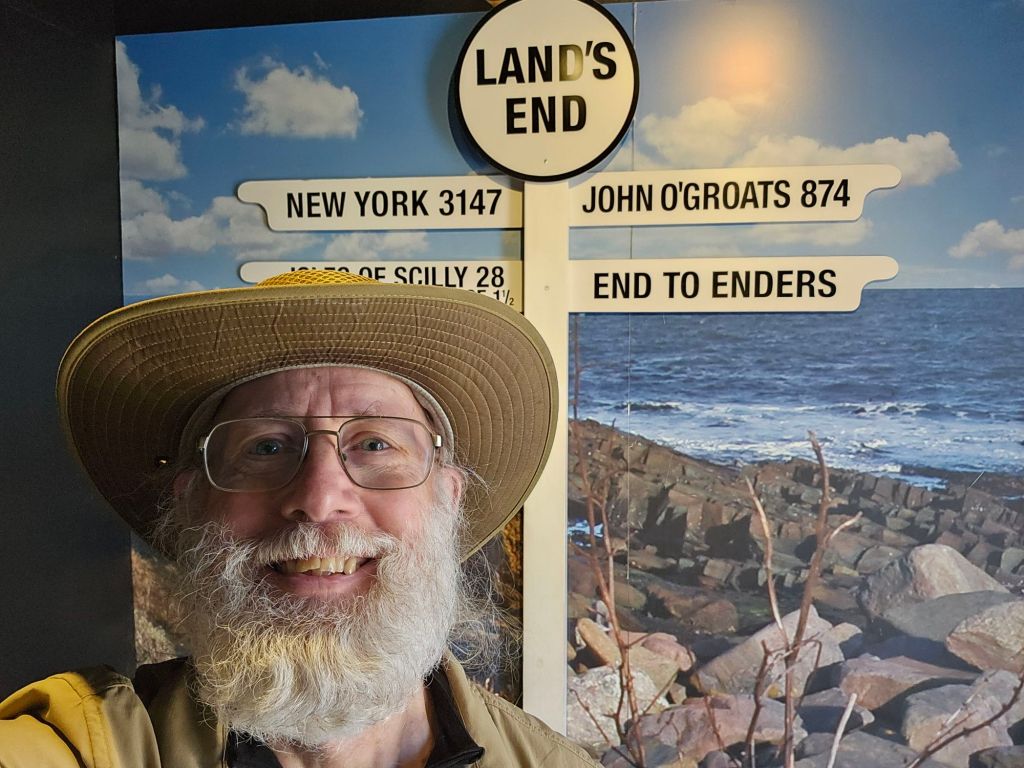
The famous signpost behind us says it’s 3,147 miles to New York. Which helps explain the polite drivers maybe.

They have a nice exhibit about LEJOG end-to-enders in one of their buildings. All about the history of doing it, and the variety of ways, as well as various records set. It only attracted one tourist while I was on site.

Tourist in the LEJOG exhibit building

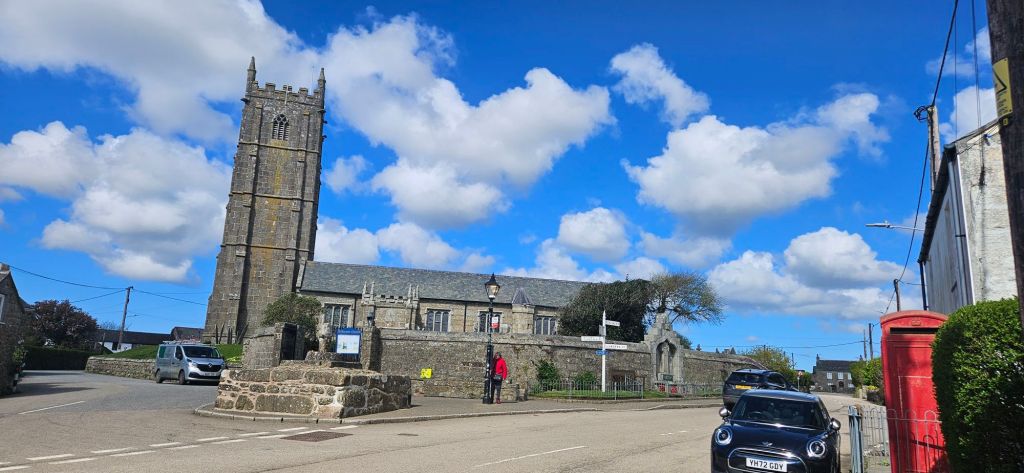
I started walking at 1:18 pm. Walked through farmland most the day. And arrived at St Buryan around 3:15. The Anglican church there is open all day to visitors, so I went in and prayed, took a few photos of the interior, walked a little of the graveyard, and then sat on a bench outside having snacks.

St Buryan’s Church
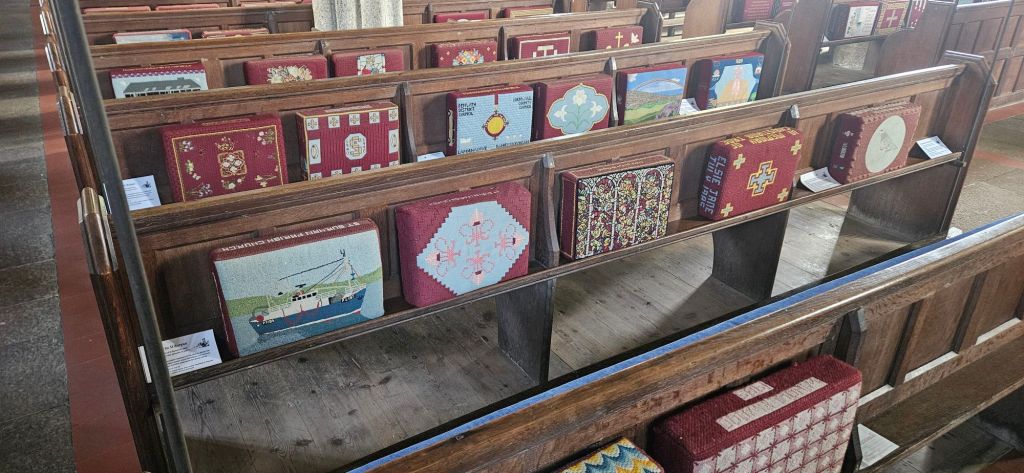
Some of the needlepoint kneeling cushions

I haven’t seen a device like this in a church before:

Tap and donate at church

The signpost outside said it’s 5 miles to Penzance. I set off at 3:43 for the second half of today’s walk and got back to the inn at 5:45.

After dinner at the Inn, I went to a grocery to feed myself the next few days.

And, so, goodnight.

Proxy Pilgrim with Springer Fever

Among American long distance hikers there’s a thing – a real thing – called “Springer Fever.” It hits this time of year. Hard to avoid. Not that you’d necessarily want to. It’s this deep urge to go hiking again, to be back in Georgia on Springer Mountain (hence the name), starting another Appalachian Trail hike. Or, for me this year, walking church to church the length of Britain.

Read more

LEJOG as pilgrimage

Okay, fine, the last posts explain what a LEJOG is, but why do it?

A goodly number of the people do this trek to raise funds for a charity. Those are the people who post and boost videos during their trip. LEJOGers who aren’t trying to reach more potential donors don’t have the same need to publicize their efforts. But there are other reasons to walk 1,000 miles.

Read more

two types of pilgrimage

“The pilgrimage idea, the outgoing quest, appears in mystical literature under two rather different aspects. One is the search for ‘the Hidden Treasure which desires to be found.’ Such is the ‘quest of the Grail’ when regarded in its mystic aspect as an allegory of the adventure of the soul. The other is the long, hard journey towards a known and definite goal or state. Such is Dante’s ‘Divine Comedy’; which is, in one of its aspects, a faithful and detailed description of the Mystic Way.” (Evelyn Underhill, Mysticism. New York: E.P. Dutton, 1912, p. 154)

be faithful to solitude

“It is not your job, however, to fix anyone else with your solitude. It is only up to you to be faithful to it when you need it, rather than feel there is something wrong with you for it. You are not alone in wanting to be alone sometimes.”

Aron, Elaine. Four Words: Downtime, Solitude, Silence, and Loneliness. Originally published in Comfort Zone Newsletter: November 2012. Read online at https://hsperson.com/four-words-downtime-solitude-silence-and-loneliness/ on 2 March 2024.


A psychologist of highly sensitive persons – she literally wrote the book on them – says to remember to take some time alone (and goes on to quote Merton as “our solitude expert”).

one Catholic view of Martin Luther

“We must see the decisive point here: more than anyone before him in the fifteen hundred years of church history, Luther had found a direct existential access to the apostle Paul’s doctrine of justification of the sinner by faith alone, and not through works. This had been completely distorted by the promotion of indulgences in the Catholic Church, which claimed that the sinner could be saved by performing set penances and even making payment of money. This rediscovery of Paul’s message of justification – among the shifts, obscurities, cover-ups, and overpaintings – is an epoch-making and astounding theological achievement, which the Reformer himself always recognized as the special grace of God. Simply in the light of this central point, a formal rehabilitation of Luther and the repeal of his excommunication by Rome is overdue. It is one of those acts of reparation which should follow the pope’s confession of guilt today.”

Küng, Hans. The Catholic Church: a Short History. New York: The Modern Library, 2003, p. 126

Meister Eckhart’s apophatic way

"The ‘way’ Eckhart proposes, so far as he does so at all, follows the apophatic route of classical Christian contemplation favoured in the Order of Preachers during his formative years and as taught by his close contemporary St Gregory of Palamas in the East and practitioners of the via negativa in the West such as Richard of St Victor. What Eckhart in fact teaches is that the silent repose of contemplation, the polar opposite of ecstatic rapture, is the ‘place of rest’ where one encounters the divine Presence in the ground of the soul.

“The elements of spirituality Eckhart would have learned as a young friar are reflected in this passage from the Summa Theologiae of St Thomas Aquinas, which Eckhart would have known well: ‘Contemplation is the soul’s clear and free dwelling on the object of its gaze; meditation is the survey of the mind while occupied in searching for the truth; and cogitation is the mind’s glance, which is prone to wander.”

Woods, Richard. Meister Eckhart: Master of Mystics. New York: Continuum, 2011, p. 100

on suffering

“Eckhart does not counsel anyone to seek suffering for its own sake, nor even as a special mode of God’s presence. In this he differs considerably from most of his contemporaries, and even some of his own disciples. Eckhart’s way is to seek God in all things, and all things in God, even suffering, not with fatalistic resignation as inescapable, but as a gift of God’s presence and companionship.”

Woods, Richard. Meister Eckhart: Master of Mystics. New York: Continuum, 2011, p. 177

public prayers

“Social and public prayers hold groups and religions together, but they do not necessarily transform people at any deep level. In fact, group certitude and solidarity often becomes a substitute for any real journey of our own. Hear this clearly. I am not saying there is no place for public prayer, but we do need to heed Jesus’ very clear warnings about it.”

Rohr, Richard. The Naked Now: Learning to See as the Mystics See. New York: Crossroad Publishing, 2009, pp. 72-3