Housekeeping note

This blog has both hiking posts and spirituality posts.

  • To read only the 2025 LEJOG Pilgrimage walk across Britain posts click the menu words “LEJOG Pilgrimage” at the top right
  • To read only the hiking posts, click the menu word “Hiking” at the top of the screen
  • To read only the spirituality posts, click the menu word “Spirituality”
  • To read all blog posts intermingled, click the menu phrase “Blog Posts”

And as a reminder, I’ve put a quick explanation of how hiking paths and the spiritual path intersect on the “About” page.

Do Lutherans Meditate?

My recent post about Lectio Divina might have raised questions such as ‘Do Lutherans, do Protestants, do Evangelicals, do Bible-believers, do Christians really meditate? Isn’t all that lectio divina stuff something only Catholics do?’

Ignoring the division that the question inserts among the followers of Jesus, the short answer is a qualified yes. The qualifications are that some people who are in those categories meditate; but that others don’t. Some Catholics practice lectio — as do some non-Catholics! — and others don’t.

You might ask now whether I think I have some new insight to share, some new information that hasn’t already been said about this spiritual discipline. Actually, all I’ve got is old information. In my spirituality post last week on Lectio Divina, I mentioned in passing that Martin Luther taught a 3-point practice of oratio, meditatio, tentatio rather than the usual 4-point lectio, meditatio, oratio, contemplatio. He specifically wrote about it in 1539, as we’ll see below.

And it’s to Luther’s version of Lectio Divina that I want to turn today.

Let’s start with Luther’s ‘First Lectures on the Psalms’ which he gave in Wittenberg 1513-1515. Note that this places the lectures between receiving his doctorate (1512) and posting his 95 Theses (1517). That is, Luther was still an Augustinian monk and faithful Roman Catholic at this point in his life.

Commenting on Psalm 1:2 “And on His law he meditates day and night” Luther explains “Meditating is an exclusive trait of human beings, for even beasts appear to fancy and to think. Therefore the ability to meditate belongs to reason. There is a difference between meditating and thinking. To meditate is to think carefully, deeply, and diligently, and properly it means to muse in the heart. Hence to meditate is, as it were, to stir up in the inside, or to be moved in the innermost self. Therefore one who thinks inwardly and diligently asks, discusses, etc. Such a person meditates.” (“First Lectures on the Psalms,” American Edition, vol. 10. St. Louis: Concordia, 1974, p. 17)

Teaching his way through the Psalms Luther eventually, of course, got to Psalm 119:24. He worked with the Latin Vulgate translation that comes out in English as “For Thy testimonies are my meditation, and Thy statutes my counsel.” (There is pretty widespread agreement, though, in modern English Bible translations that ‘meditation’ here should read ‘delight.’) Luther comments on the Latin word meditatio that he had before him:

For to meditate means to think deeply and to explore the inner parts and always to follow the spirit within and not to construct a wall for yourself and set up a boundary, as if you had already achieved the end of understanding or acting. … Therefore to meditate means to know the testimonies inwardly since they are signs and attestations of things to come.” (“First Lectures on the Psalms,” American Edition, vol. 11. St. Louis: Concordia, 1976, p. 434)

Meditation is what Luther had been taught in the monastery. It is what he passed on to his students at the university. It was his own practice.

But, someone might object, Luther was still Catholic at this point, he wouldn’t have talked about meditating once he became a Lutheran. Well listen to him again in 1539:

You should meditate, that is, not only in your heart, but also externally, by actually repeating and comparing oral speech and literal words of the book, reading and rereading them with diligent attention and reflection, so that you may see what the Holy Spirit means by them. And take care that you do not grow weary or think that you have done enough when you have read, heard, and spoken them once or twice, and that you then have complete understanding. You will never be a particularly good theologian if you do that, for you will be like untimely fruit which falls to the ground before it is half ripe.” (“Preface to the Wittenberg Edition of Luther’s German Writings,” American Edition, vol. 34. Philadelphia: Muhlenberg, 1960, p. 286)

This attentive reading and re-reading sounds very much like entering into the spiritual discipline of lectio divina, doesn’t it? I contend that’s exactly what it is.

Luther wrote this ‘Preface’ late in life when he couldn’t prevent others from gathering and publishing a collected edition of his works. It is the source of the mature Luther’s saying that the Psalms (and particularly Psalm 119) give 3 simple rules for making theologians: Oratio, Meditatio, Tentatio. You can see in the passage just quoted that he undergirds the whole process with reading (lectio) the Scriptures, repeatedly and out loud.

But what do we make of Luther’s use of tentatio rather than contemplatio? They aren’t synonyms. And the word tentatio is one of those words that translators say is really hard to carry over into English. (It often just gets left in Latin when people write about it in this context.) It means a combination of struggle, temptation, real life experience, difficulties, stress and strain, internal wrestling, opposition, and things like that. That certainly doesn’t sound like blissed out contemplation does it? Tentatio is really more related to the ‘dark night of the soul’ through which contemplatives need to go. It serves as a gateway to contemplatio, as a tollbooth on the spiritual path.

Luther calls tentatiothe touchstone which teaches you not only to know and understand, but also to experience how right, how true, how sweet, how lovely, how mighty, how comforting God’s Word is, wisdom beyond all wisdom.” (“Preface to the Wittenberg Edition of Luther’s German Writings,” American Edition, vol. 34. Philadelphia: Muhlenberg, 1960, p. 286-287)

What Luther does here is strengthen his explanation of Lectio Divina by first assuming the reading of Scripture (lectio) as its foundation. The written Word of God was foundational to everything for Luther. Then he refines the other end of the process by openly acknowledging the difficulty most Christians face in reaching the stage of contemplatio. It’s difficult because of the dark night, the tentatio. But he also shows thatcontemplatiois possible. That experience of the rightness, truth, sweetness, loveliness, might, and comfort that God wants to give is waiting for us on the other side of tentatio. This is part of the genius of recognizing and naming tentatio as part of the process.

So in the end we see that Martin Luther preserves the spiritual discipline of Lectio Divina. And he encourages its use. He does this for everyone who is walking the spiritual path. He does it for those who today call themselves Lutherans, or Protestants, or Evangelicals. And yes Luther preserves Lectio for those who call themselves Catholics, too.

[Lectio] – Oratio – Meditatio – Tentatio – [Contemplatio]
Hiking a Plan B

Hiking the Path During a Pandemic

Plans change. I’ve said before that one of the things my long hike 5 years ago (where I walked from Springer Mountain in Georgia up to Great Barrington, Massachusetts before getting off the Trail to deal with the anemia) taught me was the value of having a Plan B, and a Plan C . . . and even a Plan D.

The Plan A back in January, going into retirement, was that I would head up into New Jersey or thereabouts this July and walk north from there to Mount Katahdin, Maine.

Then covid-19 happened so, yeah, that’s not going to happen.

Some things about the long distance hiking life are just like non-hiking life. Especially during a pandemic.

The Trail was actually closed in some places back in March and April and May; both the National Park Service and the Forest Service land were closed; shelters closed; privies not maintained; the Trail itself not maintained. The Appalachian Trail Conservancy was telling people to postpone their hikes. And all that was particularly hard on hikers who had already started north from Georgia, or had quit jobs and left apartments in order to go hike. Also on hostel owners who had to close. And small town grocers who lost business. Of course, those business owners were already pretty much directed by their various state governments to close up.

But the hikers. Some got off the Trail and found their ways home. (And some of them are now back hiking again.) Others walked on. What you then saw on social media were word battles between the obedient home-goers and the resistant walkers.

As social distancing restrictions were clarified, and hand-washing regimens explained, and masking requirements implemented, you also had hikers declaring that the authorities were telling people that being outdoors for exercise was an approved behavior, and that thru-hiking is an annual experiment in social distancing anyway.

Well, yes. BUT it’s only partly about social distancing. Sleeping in a shelter makes it impossible to maintain the 6 feet of separation (“Well, I always sleep in my tent or hammock!”) and the surfaces in shared privies can’t be sanitized between uses (“I’ll go in the woods.”). And there isn’t any way to pass people on the Trail in either direction while keeping 6 feet apart, except by stepping off the Trail onto sometimes fragile vegetation, or into poison ivy, or realizing you’re on the side of a mountain and there isn’t any “side of the Trail” to step onto. And there’s heading into towns for food resupply that exposes the local people to your infections, and you to theirs. And while small hostels may now accept hikers (at less than full capacity?) the Appalachian Mountain Club has announced that its (big and expensive) “huts” in the White Mountains will be closed for the entire year (it just takes too much to open them up, staff them, and supply them for a shortened season). And even now Baxter State Park in Maine, where Mount Katahdin lives, is still not completely open, and there’s still a 14 day self-quarantine for people entering Maine (though they’ve recently implemented a testing alternative to the quarantine).

On top of which, say you’re out thru-hiking and making your way around the closures and restrictions. And say you get sick. Depending on where you are it can take a day or longer to walk out to a road. And then some time to walk the road to a town, or try to hitch a ride (hoping for an open pickup truck so you don’t infect the driver). Then where are you? Probably still miles and miles away from a hospital that might be able to begin your care.

So my Plan B for this year is to hike locally. The Appalachian Trail is only a couple miles from our house, but that access point is through a Scout camp that has shut off public access through their property. A short 7 or 8 mile drive carries me to places where the Trail crosses roads. And yes, of course, there are other trails to hike. Have a Plan B.

As luck would have it, I came across the following article while I was writing this post. It has a couple references to hiking Plan B on a trail that’s a little to the west of the Appalachian Trail: the Pacific Crest Trail. You may have heard of the PCT through Cheryl Strayed’s 2012 book “Wild: from Lost to Found on the Pacific Crest Trail” or the movie based on the book. Some of the facts about “trail angels” and that trail are also observable on the AT. Anyway, if you enjoy my hiking posts, you might enjoy this article from “Outside” magazine’s website: “Why the PCT’s Most Iconic Trail Angels Are Retiring” by Mary Beth Skylis (OutsideOnline, 18 June 2020).

[Footnote: 5 years ago today, I hiked a 23 mile day on the AT to finish the northern end of the Shenandoah National Park and spend the night at the Front Royal Terrapin Station Hostel.]

A new old practice

Today I write about the hottest new old thing that everybody’s talking about. Well, maybe not everybody, but a lot of people, a broad spectrum of Christians. It’s lectio divina, divine reading.

In its usual form today lectio divina has four parts: reading, meditation, prayer, and contemplation (in Latin: lectio, meditatio, oratio, contemplatio). Sounds sort of simple. You can look it up in your books or on the Internet and find lots of explanations of the discipline, lots of instructions. But what do those four words mean?

Because there’s reading, and then there’s reading. To the Christians who developed this practice, reading meant reading aloud. That’s how every literate person read back in the classical world and in the days of early Christianity. You already know this from having read Acts 8:30 where Philip ran up to the chariot of the Ethiopian eunuch “and heard him reading the prophet Isaiah.” Philip could hear him reading privately because he read out loud. Doing so made reading a multi-sensory act that involved one’s eyes, tongue, and ears. In the monasteries, where the practice of lectio divina was developed, private reading continued to be out loud. Maybe quietly if there were others in the room also studying, but aloud nonetheless.

Making reading a physical act instead of just a mental one has several effects. It slows reading down, for one thing. “We read attentively, seeking not to cover as much as possible as quickly as possible but to plumb the depths of the text so that the text may plumb the depths of our being and doing. Rather than an analytical approach, we take a contemplative posture that is open to ambiguity and mystery. The final goal of spiritual reading is to be mastered by God for the fulfillment of God’s purposes in us and through us.” (M. Robert Mulholland, Jr. Invitation to a Journey: a Road Map for Spiritual Formation. Downers Grove, Ill.: IVP Books, 2016, p. 129) In other words, this isn’t Bible study, nor sermon preparation time, nor research.

Reading this way also helps the reader fix the text in his or her memory, leading into the rest of lectio divina. The memorized sacred texts were/are first of all the Bible, and secondarily commentaries, sermons, and other writings by the faithful. For earlier Christians, this meant that whole libraries could easily rise up in their minds. (This, by the way, helps explain the apparently meandering outlines of much earlier Christian literature. One word or phrase would remind the writer of something similar which just had to be mentioned and commented on, which would remind him of another passage, which led to … well, eventually it either led back to his original point or there was what seems to us to be an abrupt leap back to what he started out with.) My own practice has not reached this point, not by a very long shot.

The original text then becomes fodder for continuing rumination or meditation. The words are turned over again and again as the reader seeks to find the sweet meaning in them for his or her own life at that time. Think of slow, patient cud-chewing by a cow (a ruminant!) out in her field.

Meditation on the text leads to prayer. Possibly – or even likely – not a prayer of supplication or request. More likely, I should think, a prayer that just expands the period of lectio divina from “you and the text” to a richer “God and you and the text”.

Eventually, possibly, it may be that this process carries one into the gift of contemplation. Some non-Catholics seem to treat contemplation as just another period of meditation, just asking yourself deeper questions about your reactions to the text. In contrast, it seems Catholics tend to describe contemplation as a deeper spiritual union with God, a gift. John Michael Talbot writes that “contemplation is a gift of God beyond our perception. We don’t go to it, it comes to us. It is pure union of being in Being. As God is simply I AM, so we simply ARE in him when experiencing contemplation. Contemplation happens when we stop thinking of God, and God’s idea takes over!” (The World is My Cloister: Living From the Hermit Within. Maryknoll, NY: Orbis Books, 2010, p.45). Contemplation really moves from what I am actively doing with this text to what God seems to be doing in me with this text.

Talbot outlines a “fourfold progression” of lectio, oratio, meditatio, and contemplatio. (The Universal Monk: the Way of the New Monastics. Collegeville, Minn.: Liturgical Press, 2011, p. 98-108). Martin Luther spoke of oratio, meditatio, and tentatio (the latter means suffering, temptation, stress, struggle). Mulholland shuffles the four while adding a preparatory step and a concluding one: silencio, lectio, meditatio, oratio, contemplatio, incarnatio. (Invitation to a Journey: a Road Map for Spiritual Formation. Downers Grove, Ill.: IVP Books, 2016, p.129-133). And, of course, there’s a Wikipedia article on lectio divina it has the order: read, meditate, pray, contemplate.

Thomas Merton summarized the progression this way: “Reading becomes contemplative when, instead of reasoning, we abandon the sequence of the author’s thoughts in order not only to follow our own thoughts (meditation), but simply to rise above thought and penetrate into the mystery of truth which is experienced intuitively as present and actual. We meditate with our mind, which is ‘part of’ our being. But we contemplate with our whole being and not just with one of its parts.” (The Inner Experience: Notes on Contemplation. Edited and with an Introduction by William H. Shannon. NY: HarperOne, 2003 [the text belongs to 1959!], p. 59)

However you spend time with Scripture in lectio divina, just remember that it “is not a technique, but an atmosphere or ambience within which specific actions take place. … [These actions] should not be seen as necessarily sequential.” (James W. Sire. Habits of the Mind: Intellectual Life as a Christian Calling. Downers Grove, Ill.: IVP Books, 2000, p. 153). By outlining the “steps” of lectio divina in various ways we aren’t shackling ourselves into a legalistic confrontation with Scripture. What we want is an exercise of our Gospel freedom. Merton again: “Nothing is in fact so inimical to the contemplative life as regimentation.” (The Inner Experience, p. 78)

All that said, lectio divina can be practiced in ways that suit people in today’s world who live with modern responsibilities, pressures, and commitments. It isn’t just for monks any more!

Some Words about Solitude

At the beginning of this year’s stay-at-home, social-distancing orders, several jokes and internet memes went around with similar punchlines: “I’ve been training for this all my life!” The dawning of the age of coronavirus became a time for introverts to shine, albeit mostly by themselves.

There were others who struggled with this enforced alone time from start to finish. It was difficult for them. They missed their people. They were ready for the isolation to end on day two, or maybe sooner.

And many, it seems, felt trapped in their homes with family or roommates. They couldn’t find the quiet space they needed. Others cherished the chance to finally spend extended time with just family.

Isolation, alone time, solitude — people react to this each in their own way, of course. And it strikes people differently when it is a voluntary state rather than mandated by the authorities. It feels different if you know you can ‘break out’ at any point, rather than being locked in ‘until it’s safe’ or whatever. We have to grant this from the beginning. Just as some people have real difficulty with silence, some cannot picture voluntarily practicing solitude.

Of course,” writes N.T. Wright, “being by yourself is often very desirable. … Differences in temperament, upbringing, and other circumstances have a large part to play in this. But most people do not want complete, long-term solitariness. In fact, most people, even those who are naturally shy and introverted, do not normally choose to be alone all the time. Some do so for religious reasons, becoming hermits. Others do so to escape danger, as when a convicted criminal chooses solitary confinement rather than face prison violence. But even those who make such choices are usually conscious that this is abnormal.” (Tom Wright. Simply Christian. London: SPCK, 2006, p. 26)

Why is that? Partly because we humans are social creatures, made for community and relationship. “It is not good that man should be alone.” (Gen. 2:18) So most people shy away from voluntary solitude. And that makes the choice for solitude abnormal, out of the ordinary, different from the popular choice of the masses.

Yet the discipline of solitude, while perhaps abnormal, is not wrong. Reading the lives of the Christian saints, you find that many of them spent time in solitude. Often at the beginning of their ministries, but often also at times of transition, or near the end of their earthly existence, many of these Christians have spent time (maybe years) apart from society.

Solitude, as a spiritual discipline, is a time to listen to the Lord, a time to prepare for future work or to reflect on work completed, a time to hop off the merry-go-round of life and find out what you’re being called to do next. It’s a retreat. Solitude creates necessary space that insulates you from the usual voices (usually well-meaning, but sometimes not). Stripping away those distractions makes it easier to focus on your most important relationship.

For example, you may have heard of Jesus. He spent 40 days alone between his baptism and the start of his public ministry. “The clarity of thought and action that would later characterize Jesus’ public ministry came from his years of preparation in solitude and anonymity. The core of that preparation was meeting God in the secret place of his inner self. It was through meeting God in places of solitude that Jesus discovered his identity and grew in intimacy with God.” (David G. Benner. The Gift of Being Yourself. Expanded ed. Downers Grove, Ill: IVP Books, 2015, p. 87)

Then at other important waypoints in his life the Gospels tell us that Jesus went away by himself to pray. Those shorter spans of solitude are honestly what most readers here will seek or experience. These brief, even daily, periods of solitude let us step apart to catch our breath, to re-focus, to re-center, to begin afresh.

We may even find a way to be in solitude internally while in the presence of others. Early in the 20th century Antonin Sertillanges wrote of the benefits of working in solitude, then added:

But note that this complete solitude, the only favorable atmosphere for work, need not be understood physically. Someone else’s presence may double, instead of disturbing, your quietude. To have near you another worker equally ardent, a friend absorbed in some kindred thought or occupation, a chosen spirit who understands your work, joins in it, seconds your effort by silent affection and a keenness fired by your own — that is not a distraction, it is a help.” (Antonin G. Sertillanges, O.P. The Intellectual Life: its Spirit, Conditions, Methods. Washington, DC: The Catholic University of America Press, 1987, p. 98)

This is more along the lines of our busy Lord alternating between the crowds and his disciples, taking time for others and time to be alone.

Yet not alone.

For even in the midst of lengthy periods of solitude none of us are by ourselves. Perhaps the tempter or his slaves may come to you as to Jesus in the wilderness. But perhaps he will not. Because the one who IS “with you always even unto the end of the world” (Matt. 28:20) will of course be with you in your alone time and solitude.

That last thought is why we even consider solitude to be a Christian spiritual discipline. Withdrawing from the uproar of daily life means that you can so much more easily spend time with God alone. This is important because it is how God meets us and shows us his love: one by one by one.

God is spending that time with you, certainly, but you can easily miss the chance to take advantage of it. If you fill your solitude time with your music or shows or social media tribe, you aren’t really alone. You’re with them. As I understand it that’s how many people spent the last weeks and months: filling all the empty and quiet space in their life with the digital sounds of other people.

Now that the country is opening up again (at least until the hard recoil of the virus pandemic washes back into us), perhaps you can look at how you spent your time away from your accustomed friends and co-workers, your extended family and others. Was it a fruitful time as it was for Jesus? Or did it drive you up the walls? Why was it that way?

And more importantly, how will you take advantage of the experience of enforced solitude to begin a habit of cultivating bits of spiritual solitude going forward? When you go into it voluntarily and willingly, it becomes a comfortable, relaxing, fulfilling, refreshing, renewing place of spiritual retreat.

Words about Silence

Funny thing about the spiritual discipline of silence. The more we say about it, the less we have of it. But here I go anyway, creating sentences and paragraphs to talk about the lack of them.

Some years back I started to feel overwhelmed by the sheer number of words coming at me. And I think I have a high tolerance for words, having worked as a librarian and as a preacher of the Word. There was something else going on. This coincided with what I see now was a bend in the trail of my spiritual pilgrimage.

I have pretty much always tended to the quiet side of life. But I’ve also slowly been shedding much of the external noise in my life. We don’t have a television. We don’t constantly stream shows online. There is no radio always playing in the background. Or in the car. I have no earbuds. I no longer commute 25 miles one way in city traffic (or, actually, any distance at all), and stopped downloading podcasts while I was still making those daily drives. Quieting all that external noise was the easiest part.

Another level of the walk into spiritual silence comes by silencing the social media that invade our lives and that we eagerly, and perhaps mindlessly, consume. These applications are craftily designed to draw us back in again and again. It takes an effort of the will to wean away from them. Sometimes it takes deleting the apps altogether. A the very least they need to be cordoned off so they don’t invade the life spaces you want to protect. This work is harder than the first.

But hardest of all, and in the end perhaps the most promising, is quieting the internal noise. Some people, I’ve read, don’t have much of an internal dialog constantly running in their heads. Perhaps they subsist on the “earworm” sounds of pop songs, commercial jingles, and repetitive thoughts or ruminations. I’m not one of those people. My mental space has been swept clear of much of those songs and jingles through turning off the tv and radio. What I contend with are snippets of conversations that I have had, or might have, or could yet had; or paragraphs that could end up as the written word somewhere (I’ve written and re-written whole sermons in my head while out walking). Bringing these internally-cultivated words to heel is the hard but necessary work of the spiritual discipline of silence.

Why is it necessary?

To leave space for God to enter into conversation with us.

Much, way too much, of prayer can be described as simply asking for stuff. Prayers for healing. Prayers for comfort while mourning. Prayers that violence in our streets will end. Prayers that people no longer suffer. Prayers for a job. Prayers for food and clean water. Prayers for reconciliation. All prayers asking for something.

True, Jesus himself told us “Ask and it will be given to you” (Matt. 7:7) and St. Paul urged us to “Let your requests be made known to God” (Phil. 4:7). We need to ask. If only to clarify in our own hearts what it is we are seeking, it helps to put it into words, to spell it out. It helps to get specific. And that means working through ‘what I am really asking for.’

But we also need to listen for an answer. Dietrich Bonhoeffer wrote in 1939 that

The silence of the Christian is listening silence, humble stillness, that may be interrupted at any time for the sake of humility. It is silence in conjunction with the Word. … There is a wonderful power of clarification, purification, and concentration upon the essential thing in being quiet. This is true as a purely secular fact. But silence before the Word leads to right hearing and thus also to right speaking of the Word of God at the right time. Much that is unnecessary remains unsaid. But the essential and the helpful thing can be said in a few words.” (Dietrich Bonhoeffer, Life Together. San Francisco: HarperSanFrancisco, 1954, p. 80)

Thus spiritual silence is silence with a purpose. We don’t listen for many words. We listen for the Word. And in hearing what the Word has to say directly to each of us at this moment in this place, we can know what to say and do. Because the Word of God has something to say to us as individuals (both the living Word and the printed Word). And because the Word of God gives each of us something to say to others.

The external disciplines of silence, again, are the easy part. Turn off the devices, unplug the gear, go for a walk without your tunes playing in your ears, avoid even conversations. At least for a short space each day, for a half an hour. Or longer if you can.

The harder work is seeking the internal silence that gives our God who so often speaks to his children in a “still, small voice” (1 Kings 19:12) his chance to get a word in edgewise. Just sit with God for a while. Maybe imagine you’re on a porch swing together, just silently watching fireflies rise up out of the grass at the end of a long summer day. Then stop imagining the lawn and the fireflies. And just sit together. In silence.

Yes, sometimes the Lord does call to us in thunder and loud brass instruments (Ex. 19:16). He grabs our attention away from ourselves. He shakes us up and wakes us up. But that really isn’t his voice for the day-to-day. Think about how parents will holler loudly to catch their child’s attention from the other side of a playground. But then think about how a loving parent will not holler and shout at close range and indoors. God does holler at us sometimes to get our attention. But he usually uses his ‘indoor voice’ with us. Especially when we are close by. And we want to be close by to God.

Sitting with God in silence – often, regularly, literally – is a spiritual discipline that clears the way for the Word of God in our lives.

Two Basics in a Spiritual Life

Two perennially basic elements of a spiritual life seem to be silence and solitude. And not just in Christianity. A lot of people have written about them over the centuries. And a lot of Christians have practiced these spiritual disciplines. Based on that alone, I think it’s worth spending some time considering them.

They are disciplines that are commonly linked with each other. They work together.

I write, I should tell you, as one who is convinced of the value of silence and solitude. And I write this on a day when we have a crew of house-painters clambering over the house as they chat and joke and whistle and shout to each other, as their boss gives directions and they respond, as their ladders clump against the house and as their footsteps thump across the porch roof so that they can paint the second story. This is also a day when a plumber is in and out of the house, working to open a clogged drain that defeated my best efforts and very minimal plumbing skills. And, finally, this is also a day I pushed a noisy, vibrating lawnmower around our property for a couple hours. My day has not been silent. I have not been hidden away from other people.

But it’s also a day that I started in silence and solitude, therefore a day in which I have renewed my side of the relationship the Lord has with me (something I need to do constantly). That means this is a day in which I carry a living awareness of my God with me. Thomas Merton spoke to the valuable and pervasive and persistent nature of these two disciplines in a small book titled “Thoughts in Solitude” (NY: Farrar, Straus and Giroux, 1958).

Of silence he wrote: “When I am liberated by silence, when I am no longer involved in the measurement of life, but in the living of it, I can discover a form of prayer in which there is effectively, no distraction. My whole life becomes a prayer. My whole silence is full of prayer. The world of silence in which I am immersed contributes to my prayer.” (page 91)

Of solitude: “As soon as a man is fully disposed to be alone with God, he is alone with God no matter where he may be–in the country, the monastery, the woods or the city.” (p. 96)

There is, he is saying, a gracious freedom that is rooted in these prayer disciplines, a freedom that carries over in space-time wherever and whenever a disciple goes. “My whole life becomes a prayer” (not just those minutes spent with folded hands and closed eyes). I am “with God no matter where [I] may be” (not just while in church or Bible study or other ministry activity).

If the image of the Christian life as pilgrimage works for you as it does for me, perhaps it will help to think of silence and solitude as the two sides of the path. On a hiking trail the exact edges are usually not clearly specific. The path blends out into the forest floor; the moss and fallen branches, the leaf litter and wildflowers blend back into the treadway. But the edges do define the difference between path and not-path. So, I think that guided both by solitude and by silence we can make our way along the spiritual pilgrimage of our lives. We may make our way without paying these disciplines any direct attention (as you can hike without concentrating on the edges of the trail). But I’d suggest that if we try to live without any silence and without any solitude, we will eventually find ourselves completely off the spiritual path, trying to bushwhack our way to our goal. It can be done, but it’s harder.

Keeping to the spiritual path is an intermediate goal that helps us along the way to God. Some days it’s easier than other days. Today it hasn’t been particularly easy. But, despite the disruptions of painters and plumber and push-mower, my heart rests in the peace that passes all understanding.

These disciplines are things I will be exploring in further posts. There are aspects of these simple-sounding spiritual tools that I think I can share, things that might make it easier for you to enjoy them too. Or at least, perhaps you will come to understand why some believers believe that paying attention to silence and solitude are vitally important.

The Pilgrimage Metaphor

David Benner seems to dash a founding idea of these spirituality blog posts when he writes:

“When applied to the spiritual life, the metaphor of a journey is both helpful and somewhat misleading. Helpfully it reflects the fact that the essence of spirituality is a process–specifically, a process of transformation. Unhelpfully it obscures the fact that we are already what we seek and where we long to arrive–specifically, in God. Once we realize this, the nature of the journey reveals itself to be more one of awakening than accomplishment, more one of spiritual awareness than spiritual achievement.” David G. Benner, The Gift of Being Yourself. Expanded ed. (Downers Grove, Ill: IVP Books, 2015), page 3.

Like so many other things, Benner points out, the metaphor of spiritual pilgrimage is a coin with two sides. Yes, it can be helpful; but not always and not in every detail.

I tend to find it more helpful than not. So let me speak about his objection that “it obscures the fact that we are already what we seek and where we long to arrive–specifically, in God.” This is true. But only, or especially, for people who are believers. There are others who do not (yet?) believe. They are seeking Him yet. Perhaps in unhelpful way or in unhelpful places. But seeking nonetheless. In seeking, they are on a journey to a place and to the One they do not know.

Believers, on the other hand, are clearly “already … where we long to arrive.”

So how can we use the ‘spiritual life as pilgrimage’ metaphor if we are already where we want to be, that is, close to God or even in God?

First, we say that the seekers – while already in God in a sense – are still ‘on the road’ to that place where they can finally see that God is as close as their own skin.

But, second, I believe we can also say that believers in God are still themselves ‘on the road’ as they seek a deeper and richer relationship with God. God is by definition vast, immense, huge, without boundaries of either time or extent. So there is really no way to be outside of, away from, or distant from God. But at times we may not recognize or feel how close God is. That does not mean He isn’t close. Acts 17:27 tells us that God “is actually not far from each one of us.”

So we can think of the continuing spiritual pilgrimage of believers as an exploration quest. We are engaged in poking around, sounding out, mapping, discovering for ourselves (and others, maybe) all the heights, the depths, the north-east-south-and-west of the unending beautiful landscape we call God. It’s as if we have the freedom to explore an entire continent on foot; we can never exhaust the possibilities.

That is the spiritual life I write about. That is the function of the various spiritual disciplines I want to explore. Benner is quite right that this pilgrim life is neither accomplishment nor achievement. It is not something we do or grasp or win. It is a gift we receive. It is who and what we are.

Besides all that, speaking as a long distance hiker, the metaphor strikes me as full of nuggets to mine.

Rebooting

Rebooting my feet AND rebooting the blog.

(…and hello especially to the few people in the world who subscribed to this blog 5 years ago when I made my Appalachian Trail thru-hike attempt)

I had talked about getting on with the Appalachian Trail in the summer after I retired. That’s one kind of rebooting.

Then the novel coronavirus happened.

The short of it is that I’m not going to be trying to finish off the remaining 373.1 miles later this summer as I had once hoped.

In the mean time, I’m planning on broadening the focus of the blog. This is the other kind of rebooting. I want to speak to more than just hiking on a physical path. There are other paths. I want to include now writing about the spiritual path. It’s not just a metaphor. It’s real, as real as that bunch of dirt and rocks stretching from Georgia to Maine.

I will still write about hiking the Trail, especially since we now live just a couple miles from it and since (barring pandemics) I could theoretically be on the Trail pretty much whenever I want. I will write about the Trail and post photos from it when I’m out there pursuing my dream of walking the whole thing.

Still with me? A quick way to separate the two kinds of posts will be to look at the “Category” each is assigned, either “Hiking” or “Spirituality.” (This particular post is in both.) I think I can set it up so you can subscribe to a feed of only one sort, but I haven’t done that yet.

Stay tuned. Thanks!

Well, that was unexpected

When one makes the start of an activity very public, as I did with this hiking stuff, I think it only fair that the conclusion (even if unexpected) also be public. I’ve been trying to come up with a witty way of writing about my early return from the hills, but haven’t been satisfied with anything I’ve come up with. This will have to suffice.

So anyway [as the modern locution goes] I’m home again.

I was out hiking for 8 days, and found out several things, including that

a) I wasn’t having a lot of fun out there this summer, because

b) the White Mountains in New Hampshire were beating me up (I could post pictures of my bruises, scrapes, and swollen ankle, but we all know nobody wants that), and

c) although I kept telling myself that “I may not be as fast as the kids out here, but I’m among the faster 62-year-olds on the Trail” it was becoming clear that even that wasn’t going to be fast enough to get me where I needed to be before night fell each evening, so

d) I was actually concerned about preserving my life and limb on this part of the Trail.

All of which added up to me deciding to get off the Trail in Franconia Notch, NH. That’s where the Trail crosses under I-93. Ann drove up and retrieved me. [THANKS, ANN, YOU’RE WONDERFUL!!] We got home earlier today.

Total miles backpacked on the Trail: 1816.7. Miles left unhiked: 373.1. If and when I go back to finish (and, frankly, at this point it’s more if than when) I will do some things differently in order to deal with the problems that arose this last week.

Anyway, thanks for playing along at home. I think I will add a few pictures and maybe some commentary at some point, so you subscribers may get further alerts that the blog has been updated.

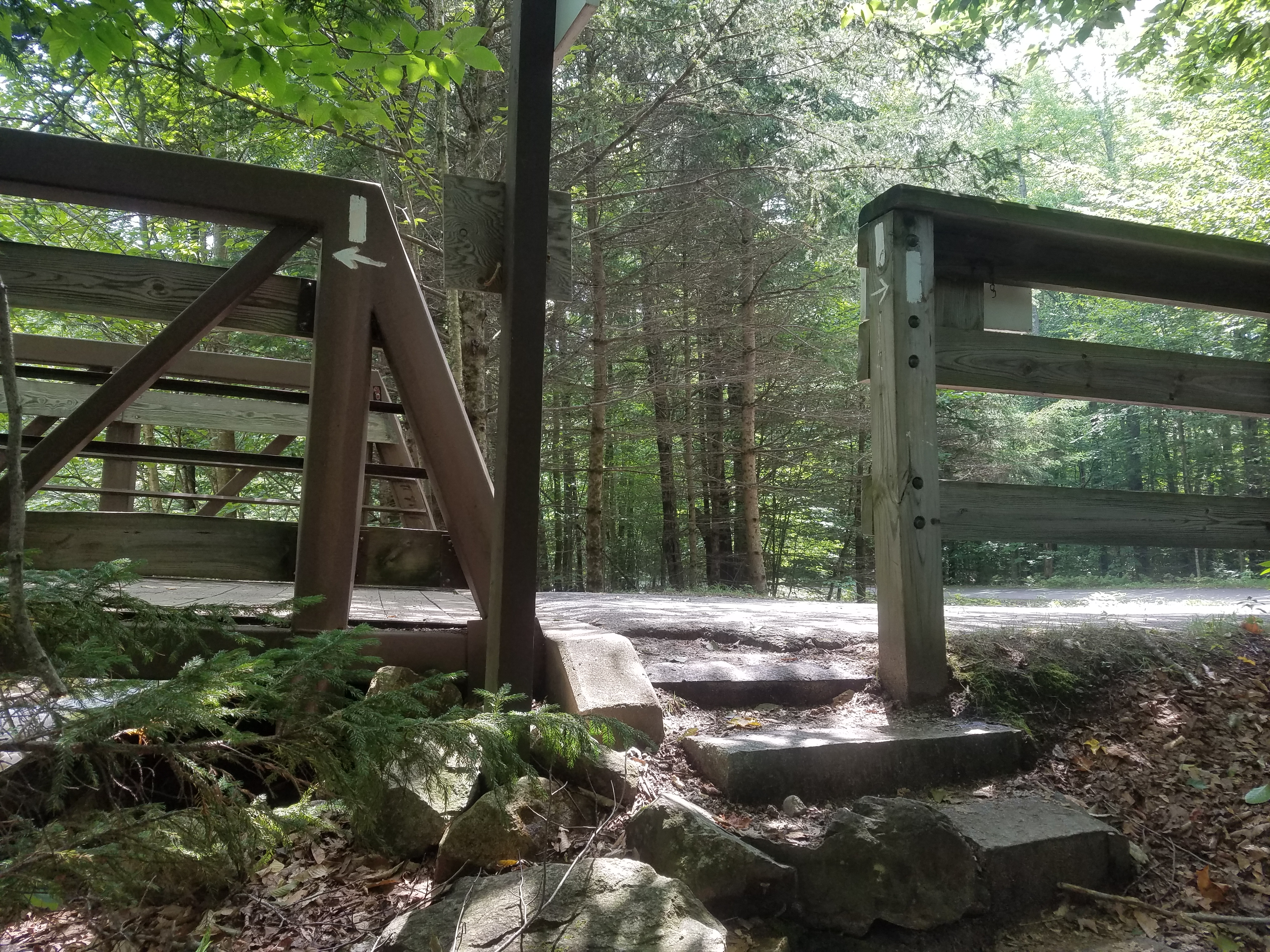
For now, here’s a picture of my “last blaze.” The Trail turns north to the left. I turned turned to the right, heading to a parking lot from which I hitched a ride into Lincoln, NH (and then — long story — walked a couple miles up thru North Woodstock to a motel).

20170822_130919