after a murder

“You would do wrong to be so hard-hearted as not to be stirred by this murder, or if you acceded to it and did not wholeheartedly condemn it. It would be equally wrong to curse the murderers, desire revenge, or nurse hostility rather than to pray for them.” [the murder victim in this case was their pastor]


Martin Luther. “A Letter of Consolation to the Christians at Halle Upon the Death of their Pastor, George Winkler” (1527) Luther’s Works Vol. 43. (Philadelphia: Fortress Press, 1969), p. 164.

a noisy Church

“It is time to revolt against the dictatorship of noise that seeks to break our hearts and our intellects. A noisy society is like sorry-looking cardboard stage scenery, a world without substance, an immature flight. A noisy Church would become vain, unfaithful, and dangerous.”


Robert Cardinal Sarah with Nicolas Diat. The Power of Silence Against the Dictatorship of Noise. With an Afterword by Pope Emeritus Benedict XVI. Translated by Michael J. Miller. (San Francisco: Ignatius Press, 2017), p. 240.

praying in the middle

“To sum up, in prayer there is the danger of falling into one of two opposite extremes. The first is ‘mythologizing’ (or making into an idol) the external forms, when prayer is reduced to the mechanical following of a rule or a method of praying. The second is the rejection of and allergic reaction toward all forms of prayer and asceticism. Those fall into this sad situation who do not know how to combine the external forms with sincerity of heart.”


Augustine Ichiro Okumura. Awakening to Prayer. Translated by Theresa Kazue Hiraki and Albert Masaru Yamato. (Washington, DC: ICS Publications, Institute of Carmelite Studies, 1994), p. 52.

a hermit’s dark night

“The solitary easily plunges to a cavern of darkness and of phantoms more horrible and more absurd than the most inane set of conventional social images. The suffering he must then face is neither salutary nor noble. It is catastrophic.”


Thomas Merton. “Notes for a ‘Philosophy of Solitude’.” (1960) in Selected Essays. Edited with an introduction by Patrick F. O’Connell. (Maryknoll, NY: Orbis Books, 2013), p. 72.

What is the Church?

“The church is the single multi-ethnic family promised by the creator God to Abraham. It was brought into being through Israel’s Messiah. Jesus, energized by God’s Spirit, and it was called to bring the transformative news of God’s rescuing justice to the whole creation. That’s a tight-packed definition, and every bit of it counts.”


Tom Wright. Simply Christian. (London: SPCK, 2006), p. 171.

Lectio divina at the center

“Every day we monks live in important spiritual practices, such as stability, attentiveness or mindfulness, meditation, silence, prayer, obedience, purity of heart, simplicity, openness, and many others. But lectio divina is the center of our monastic life. Monastic practices are not simply things to do. They are dimensions of the Spirit. If we cannot live these dimensions, we are not really monks.”


Alessandro Barban. “Lectio Divina and Monastic Theology in Camaldolese Life” in Belisle, Peter-Damian, editor. The Privilege of Love: Camaldolese Benedictine Spirituality. (Collegeville, Minn.: Liturgical Press, 2002), p. 59.

Cluttered Mental Attic

“Before long it occurred to me to do what historians are professionally equipped to do. Live with a cluttered mental attic; run a spiritual antique shop; resist the impulse to throw anything away. Hang on after the avant-garde rejects. Save, shuffle, classify, enjoy the relics. Eventually shapes emerge. One learns to live with contradictions and paradoxes, but what is new about that in theology?”  

Martin Marty in “Theology Today,” January 1972, p. 472.

commonplace

“My life has always been more or less detached from the life about me. I have not been a hermit, but my temperament and love of solitude, and a certain constitutional timidity and shrinking from all kinds of strife, have kept me in the by-paths rather than on the great highways of life. My talent, such as it is, is distinctly a by-path talent, or at most, a talent for green lanes and sequestered roadsides; but that which has most interested me in life, nature, can be seen from lanes and by-paths better even than from the turnpike, where the dust and noise and the fast driving obscure the view or distract the attention.”

John Burroughs. “The Summit of the Years.” The Writings of John Burroughs. 15 vols. The Riverby Edition. (Boston and NY: Houghton Mifflin Co., The Riverside Press Cambridge, 1904-1913) Vol. 15, pages 1-2.

Privilege of Pandemic Hiking

An article by Grayson Haver Currin that showed up yesterday on the “Outside” magazine web site talks about the important topic of the privilege of pandemic hiking. And, although I only uploaded my previous hiking post at the beginning of the week, I wanted to toss this out there for you to see.

Currin writes about the first two people known to have finished thru-hikes on the Appalachian Trail this year. Like so many other things during this pandemic year, the count of hikers will take a hit in 2020. These two hikers, though, will be part of the final tally.

So far, no big deal. Someone has to be first each year. But the author makes very clear that these hikers pushed through to the end illegally. They walked through parks and forests that the authorities had closed. They did not follow stay-at-home orders in the states they walked through. And they intentionally avoided or disregarded law enforcement officers along the way. These two hikers happen to be young white males. Therein lies the privilege.

Currin tells us that “the pandemic and concurrent protests over racial injustice are timely reminders of entrenched patterns in the thru-hiking community—it remains, overwhelmingly, the domain of educated white men.”

These hikers’ “decision to press on along the Appalachian Trail highlights questions of privilege and pride that have long plagued the outdoor industry. “By hiking now, you have created a narrative that says, ‘My personal needs and desires outweigh a greater societal mission. At the end of the day, what’s really important is what I want,’” says Sandi Marra, the ATC’s president and CEO.”

So, yeah, these two guys spent 4 months walking the 2,000+ miles in 14 states that constitute the Trail. But even out in the woods some things are exactly like they are in the city.

Here’s the article: “The Thru-Hikers Who Finished the AT During the Pandemic

Hiking and Life

Five years ago this morning I was waking up at a place in Maryland called Raven Rock Shelter, along the Appalachian Trail. I’d been having a off-and-on kind relationship with water that weekend.

On Saturday I’d hiked into the Washington Monument State Park in a heavy rain. And it’d been raining all day. I think that really was the most rain I had on that hike. Everything I carried was thoroughly soaked. But, very fortunately, Ann had arranged to meet me there in the park and whisked me off to a nearby motel where we spent pretty much all evening on my gear: washing and drying clothes, doing a little sewing, and using the room’s hair dryer trying to dry out my shoes.

Sunday the 28th dawned sunny and dry. Back on the Trail I ran into a hiker who asked whether I had any water to share. (Ah, if only you’d been here yesterday!) My trail journal says that he first asked if I had a water filter he could use since he hadn’t brought one with him. Turns out he didn’t have a suitable container to attach my filter to. So I offered him the 32 ounces of water I had with me, and he emptied that into the container he did have. He thanked me, I wrote, “because the 64 oz. he already had might not get him to the shelter.”

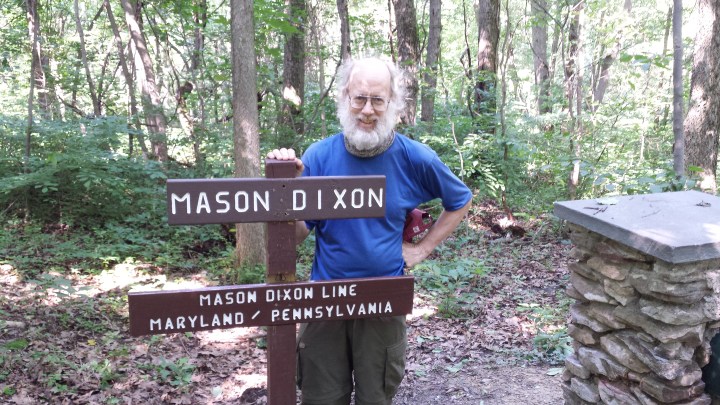
I ended up being a little short of water that evening at Raven Rock, though I had enough to make supper and have some for the morning. And I could easily fill up at a park that was 5 miles ahead right on the Mason-Dixon Line.

Sign at the Mason-Dixon Line

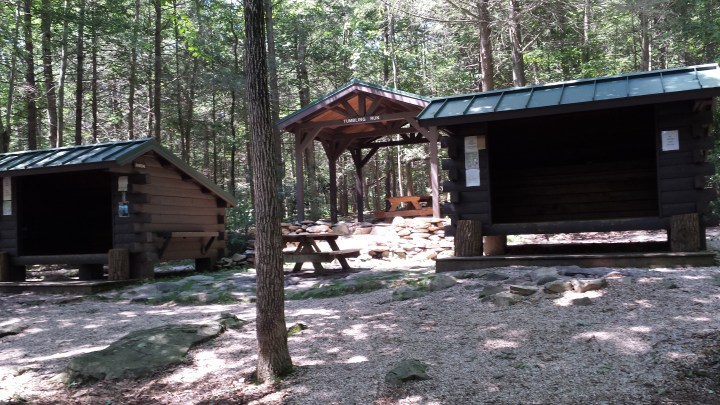
The evening of Monday the 29th I stayed at the Tumbling Run Shelter(s) in Pennsylvania. It is one on the very few spots along the Trail that has two separate shelters, and a covered picnic table. It feels like a resort when you get there.

Tumbling Run Shelter

I noted in my journal that as I wrote I was listening to a conversation of 5 fellow hikers, 3 American girls and 2 German guys. They had taken up with each other some ways back and were hiking together. I’d first met them the night before at Raven Rock. Here they were discussing whether or not to keep going after only 13.2 miles. And how far they wanted to go each day for the next few. And on and on. I wrote that “They may just discuss it so long that it doesn’t make sense to walk on tonight.” Which is what happened in the end.

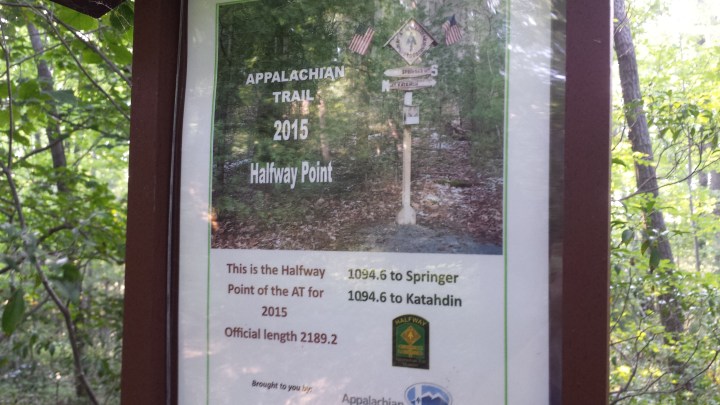
Reaching a consensus in a situation like that is difficult — and one of the reasons I prefer to hike alone. I don’t know how long they stayed together as a “tramily” (the term many hikers use these days for ‘trail family,’ that is, the ad hoc group of people you intentionally hike with for some period of time, maybe even for most of the Trail). But they were at least still together on 1 July when I last saw them at Pine Grove Furnace State Park where we took part in a time-honored hiker ritual of eating a half gallon of ice cream to mark the half-way point along the Trail. That’s half a gallon of ice cream each. Some people find it easier than others.

Sign at half-way point on The A.T.

I keep saying that long distance hiking is like life (or it could be the other way around, I guess). It includes family, hard work, struggle and progress, meeting people, helping strangers, sharing experiences, losing touch, relaxing, time together and time apart, and the occasional ice cream.