The village of K– was my immediate goal. To see an 800 year old yew tree in their churchyard. They’d mentioned it on their web page. That seemed important enough to go a ways off route.
As I was leaving the town before K– I checked the map on my phone and everything seemed in order. Soon, I came to the ‘roadwork ahead’ sign. But I knew that was directed at the drivers of cars, lorries (trucks), and busses. On the narrow country lanes it’s hard enough to get through when the road is fully open. Walkers can always get along the side, or even leap over a trench. A little road construction poses no obstacle to a walker.
Except when it does.
The next sign read “Road Closed Ahead.” But I still had seen no sign of work. A few bends in the road later, another Road Closed Ahead appeared. Still no work.
Finally, after a little over a mile, I could see something blocking the road ahead. As I got closer it resolved into fencing across the width of the road. And finally I stood next to a fence that fully and completely blocked the road, wedging itself into the hedges on both sides. No gaps. No room. No going forward.
And if there had been, I would have had to break through a similar blockage about 50 yards ahead, on the other side of the construction zone … in which I could see no construction whatsoever.
The frustrating part was that I was quite sure I was close to the road that would take me directly to the village of K– and its ancient tree. But I had to turn around and retrace my steps.
I looked at the first road I came to and saw a sign that said simply “No Entry.” This wasn’t looking good. I gave it a shot anyway. Eventually I met a woman walking her dog (it seems that at least every other person in England owns a dog). I asked about the “no entry” and she assured me that, no, I could get through to the main road. And I could.
Had to walk that main road, facing its busy traffic with really no “verge” (that is, shoulder or green space) on the side for a good, slow bit. It was the only way to get to K– and that tree I wanted to see. Not too long after, I took a right turn, but so did the traffic. And finally I got to the turn I needed.
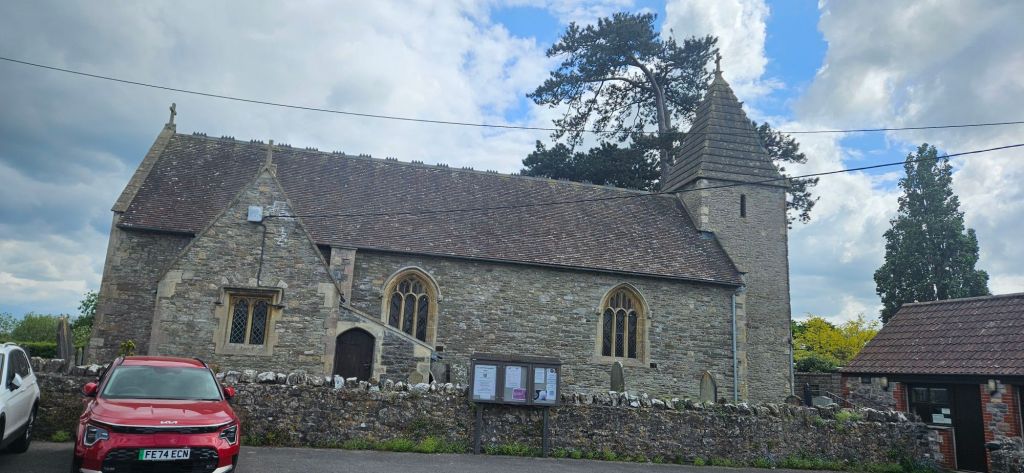
A few buildings in from that main road sits the church. Its long side faces the road. Its south side door (almost always the main entrance) was on the opposite side, facing the cemetery. I looked around for the 800 year old yew. But couldn’t locate it.
This was really getting frustrating. Did God not want me to see the tree? Had it recently died? Was it on other nearby land that the church owned?
I did go inside the church to say my usual prayers. Then came back out to the cemetery to sit on the bench and have a snack. I’d planned on getting further that day, but the diversion (detour) had taken time and energy from me. I had to decide where I wanted to end up that afternoon, where I wanted to sleep.
One thing about this kind of walking is that when you stop you can get chilled quickly. Especially if there’s a breeze. And there was a light breeze. And late in the day it was cooling off.
So I left my pack on the bench and stepped into the open-ended south porch to sit there and consider my options.
Which is when I discovered the ancient yew tree. It was in a different village named K– in a whole different county from where I was. I has misread the web page. So all that effort and backtracking and heavy traffic had been for nought. Or not.
I was looking at the maps on my phone trying to guess where I could still get to – and thinking I’d be happy to stay where I was – when I heard a voice outside make a remark about my pack. It was the church member come to close and lock the church for the night.
We got into conversation about my walk and his church. Then he performed his duty as an Englishman and asked if I would like a cup of tea. When he brought it back across the street with a few biscuits, I told him “Thank you very much, it’s gotten chilly. But what I’d really like is permission to sleep in the churchyard here, just my sleeping bag, not my tent. Or to lay it out here on the porch as I did at [another church].”
“Well, I’d have to ask,” he replied, and disappeared again. When he came back he told me no, not outdoors there, but how about sleeping IN the church?
I was and am amazed. I took my gear into the church and opened out my sleeping bag in the aisle for when it got dark. I sat in one of the back pews drinking my tea and munching biscuits. Then my new friend came back with his wife (I think she wanted to meet this American that her husband had been talking about). They wanted to make sure the toilet was unlocked and that I knew where it is. And almost immediately after, one of them returned to ask if I would prefer sleeping in a small room with a heater that the church offers to rent out by the hour to people who need a place to meet or work. I preferred the church nave itself.
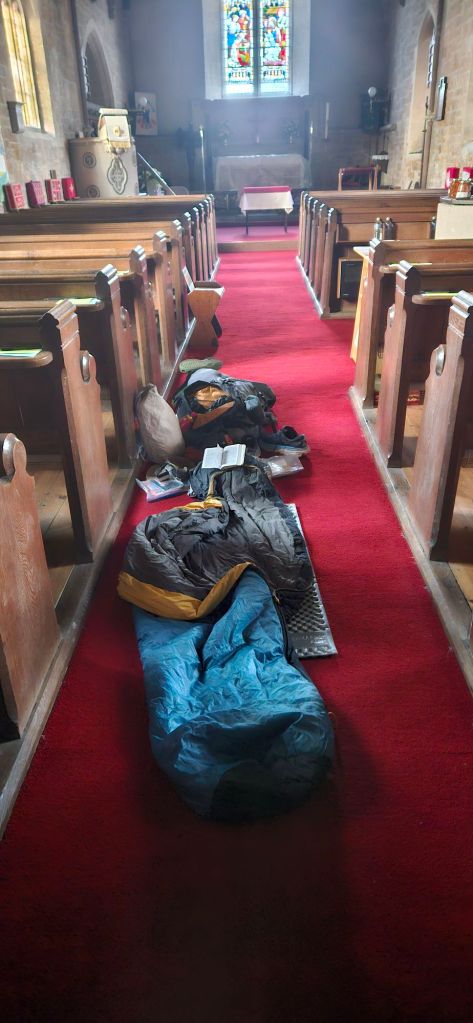
So I settled in for the night. Except for yet another visit bringing a thermos of tea. And a hot water bottle.
I spent a wonderful night sleeping in the Lord’s house, watching the stained glass as it got darker, reading from John’s Gospel and from The Imitation of Christ, praying like Samuel “speak, Lord, your servant heareth.” (I didn’t get any dramatic messages.)
As I was indoors, the birdsong did not get to me as early as usual, but it was still only sunrise or so when I was up and packing to go. Which was when I was visited again and asked whether I would like coffee or tea? And maybe some muesli cereal with milk?
Some people practice Christian hospitality as a virtue. The couple I met in the village of K– did not practice hospitality. They lived it. Seeing that old yew would have been nice. But I believe I got an even better deal.
 Pathology: the Study of a Path
I’m curious about your not naming the town you were in. Is there a particular reason? So glad for the hospitality shown 🙂
LikeLike
I just didn’t want to expose them to more random walkers than they are equipped for, especially if other visitors come expecting the same things I was blessed to receive. It’s a very small village.
LikeLike
Pretty good Benedictines, too:
LikeLike