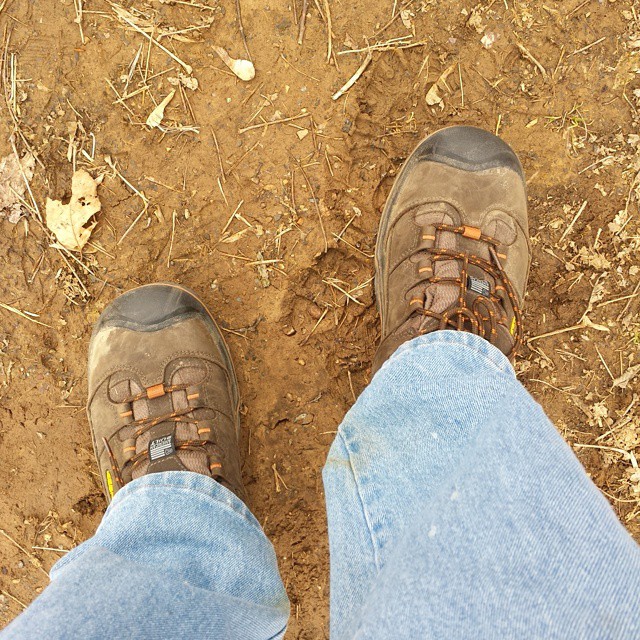
Boots’ first time on the Appalachian Trail ( in Pennsylvania today ). In 3 weeks they and I will be in Georgia. #AT2015
via Instagram http://ift.tt/1DUlAfo
via Instagram http://ift.tt/1DUlAfo
One of the long-standing traditions among A.T. thru-hikers is the use of trail names, that is, nick names, almost to the complete exclusion of real names while hiking the Trail, talking with other hikers, or writing about one’s hike.
Sometimes the names are given by other hikers. Sometimes they are self-chosen. The names seem to be inspirational or physically descriptive or literary or just plain funny. The point — I think — is to make it easier to talk with and about other hikers. Names like “Shiny Boots” or “Silver Eagle” or “Aragorn” are more memorable. They’re easier to recall than trying to remember “Now was it ‘John’ or ‘Dion’ or ‘Don’ or something else?”
Or maybe it’s escapist. People sometimes hike to get away from their other life, wanting to leave that life and all its trappings right down to their given names all behind.
One thing I know about this is that when I hiked the Long Trail in Vermont (270 miles from Canada to Massachusetts) back in 2002, I spent time throughout the month with a guy whose trail name is “Wideload.” It was given to him during an earlier A.T. hike when his pack was so wide that he couldn’t walk through a door unless he turned sideways. I have no idea what his given name is. And he surely has no idea what my given name is. At best he would remember my trail name.
My trail name is one I gave myself when I started the Long Trail hike. It was mostly based on my professional resumé at the time. I had graduated from Concordia College in NY, and Concordia Senior College in Fort Wayne, and Concordia Seminary in St. Louis; had worked at Concordia Historical Institute for 6 years; and was at the time of the hike working at Concordia College back in New York. So I chose to go by the name “Concordia.” (I always had a creative mind!)
Given the widespread lack of Latin these days this name is a little harder for people to remember out on the Trail than if I were calling myself “Moss Man” or “The Hiking Librarian.” And when people have asked about the origin of the name I have sometimes just said that it’s Latin for ‘harmony,’ which explanation seems to satisfy people. (They probably think it’s an aspirational name, that I am striving to live in harmony with nature or people or whatever.)
What I didn’t realize when I hiked the Long Trail was that there would be a lot of Canadians out hiking for whom “Concordia” meant Concordia University in nearby Montreal. Ah, well. The name did also lead to a conversation with someone who connected it to the Concordia College in Austin, TX, which is actually closer to my roots than Montreal is.
All this is a long way of saying that a month from now when I am starting my A.T. hike, I intend to sign the first and last log books with my ‘real name’* and the in between ones with my old ‘trail name’. And I am able to back up the name (and possibly help people remember it) by wearing a Concordia hat that Ann bought for me. Here are the hat and its back-up:
![20150313_072601[1]](https://kurtbodling.com/wp-content/uploads/2015/03/20150313_0726011.jpg)
*(Some of you wouldn’t know that I have for years thought of my real name as providentially pointing me towards this hike. I am Kurt A.T. Bodling. Now, the “A.T.” on my baptismal certificate doesn’t refer to the “Appalachian Trail,” but still . . . . )
Six weeks doesn’t seem like a very long time yet to go.
I have a lot of little details yet to wrap up before I’m ready to hit the Trail. Like pulling together a first aid kit. Or getting a really small toothpaste tube to take along. Or nailing down just where I think I might “re-supply” (that is, get the next few days’ worth of food either by mail or at a grocery store).
That last one is actually not a little detail.
Lots of people hike this Trail with little or no planning. At least they start that way. I don’t know what the stats are on whether detailed planners are more likely to finish the whole hike. But I do believe that the flexible schedulers are more likely to. And by nature I’m a scheduler.
So, for example, I have been trying to chart out how far I think I will get by this or that date, in order to be able to tell family and friends when I will be in their region. My approach, of course, is to go to the books. I pulled some of the hiker narratives off my shelves and built a spreadsheet of where they were when, adjusting their start date to match mine. Did that with 4 different hikers. Turns out they took widely varying amounts of time to complete their hikes: from 111 days to 147 days.
Then I came across a chart of post offices one hiker used, with the days he was able to get to each one. Great spreadsheet, too, because it also showed how many miles between these food drops, how many days of meals each box needed to contain, and how many miles per day it would take to get to that post office. Best part for me is that after charting it out, I saw he took 152 days, which is about what I’ve been thinking I will be aiming for: just about 5 months, but leaving myself a month of leeway. Excellent!
Then this guy’s spreadsheet also had a formula in it to recalculate the days and dates for each stop, based on start date. I changed the date to 13 April, and voila!, there are the dates I might be at those locations.
Now the flexibility part: fully one third of the calculated target dates are on Sundays. And post offices aren’t open on Sundays (a lot of these small post offices don’t have much in the way of Saturday hours, either). So be flexible: a) hike faster or slower in order to start hitting the post offices during the week; b) switch to other options like having packages sent to hostels or other hiker-friendly businesses; c) aim to resupply more at grocery stores than through the mail; d) make whatever adjustments it takes.
I have to, in other words, schedule in some spontaneity!
And I have 6 weeks from today to do it.
 Pathology: the Study of a Path